Cervical And Vaginal Cancer Screening In 2026 Medicare After Sixty Five
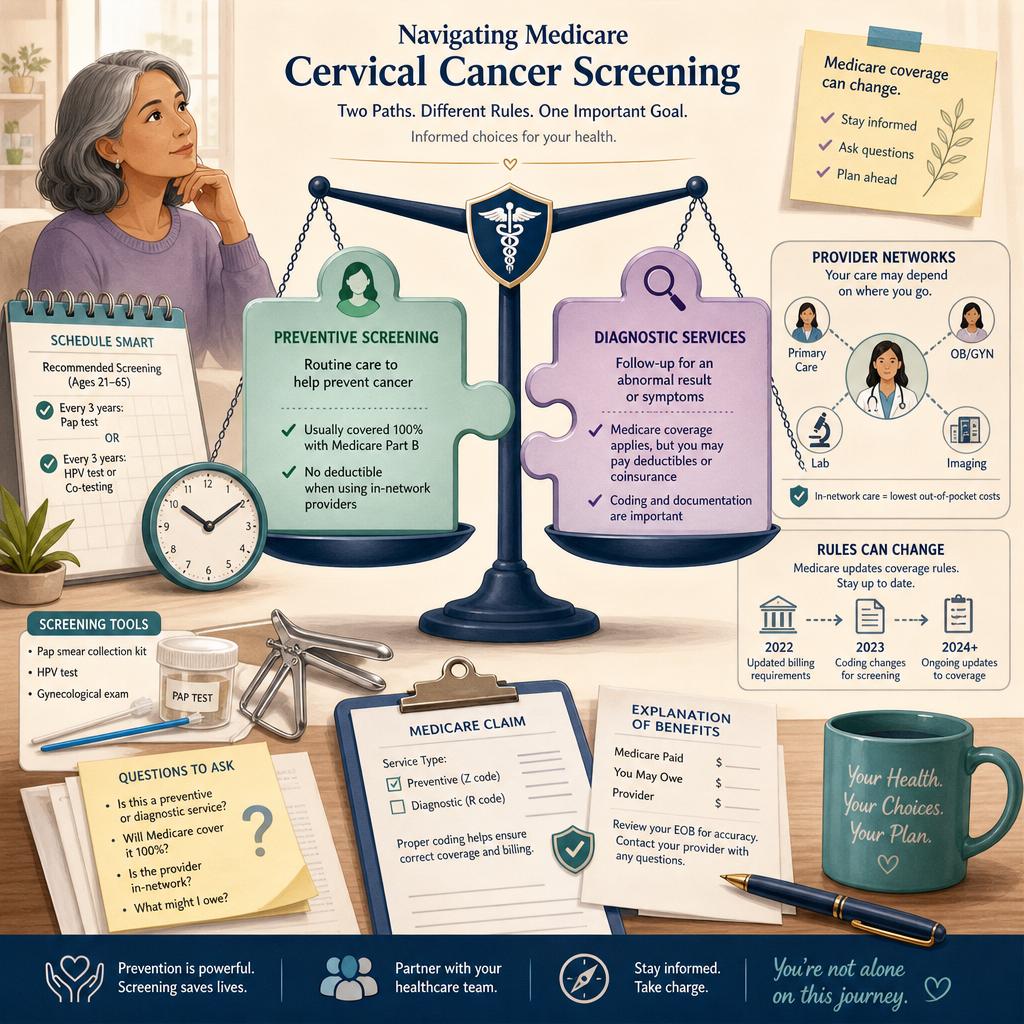
Many women arrive at Medicare with a quiet assumption: once they pass sixty five, cervical cancer screening is either automatic, unnecessary, or no longer covered. In real life, the answer is more careful than that. A woman who had normal screening for years may be on a different schedule than a woman with a history of abnormal Pap results, cervical dysplasia, immune suppression, or a prior cancer diagnosis. In 2026, the Medicare question is not simply whether the test is covered. It is whether the timing, provider billing, plan network, and reason for the visit all line up.
Consider a retired teacher who schedules what she thinks is a routine gynecology visit in March. She asks for a Pap test, mentions intermittent pelvic discomfort, and also wants to know whether she still needs HPV testing. The front desk may call it preventive. The physician may document part of the encounter as diagnostic. Medicare may cover the screening component at no cost when the assignment rules are met, while other services on the same day can generate deductible or coinsurance exposure. That is the kind of Medicare complexity that rarely appears in a simple benefits summary.
The Screening Benefit That Many Women Stop Asking About
Medicare covers Pap tests and pelvic exams to check for cervical and vaginal cancers. As part of the pelvic exam, Medicare also covers a clinical breast exam to check for breast cancer. In most cases, Medicare covers these screening tests once every twenty four months. If a beneficiary is considered high risk for cervical or vaginal cancer, or is of child bearing age and had an abnormal Pap test during the past thirty six months, Medicare covers the screening once every twelve months .
That distinction matters because Medicare coverage is built around clinical risk, not personal preference alone. A patient may feel that an annual exam is prudent, especially if she saw a gynecologist every year before Medicare. Yet if the service is billed as a screening and the beneficiary does not meet the higher risk criteria, the twenty four month interval can become the controlling rule. When a physician recommends more frequent evaluation because of symptoms or a medical finding, the claim may move from preventive screening into diagnostic care, which is often covered differently.
HPV Testing Has Its Own Age And Timing Rules
HPV testing is one of the most misunderstood parts of this benefit because it is not simply a standing annual test for every Medicare beneficiary. Medicare covers Human Papillomavirus testing as part of a Pap test once every five years for people ages thirty through sixty five who have no HPV symptoms . For a woman who is newly enrolled in Medicare at sixty five, this can be a meaningful detail. She may still fall within the covered age range, but the five year timing rule and absence of symptoms are central to how the claim is treated.
The practical issue is that many beneficiaries do not know whether their gynecology visit is being scheduled as a screening, a follow up to a prior abnormal result, or an evaluation of a current symptom. Those categories sound similar in conversation, but they are not identical in Medicare billing. A Pap test obtained because the patient has bleeding, pain, a visible lesion, or a prior abnormal finding may be handled differently than a routine screening Pap. In an Original Medicare setting, that difference can affect whether the beneficiary pays nothing or faces Part B cost sharing.
Why No Cost Does Not Always Mean No Bill
For the covered screening benefit, Medicare says you pay nothing for the lab Pap test, the lab HPV test with the Pap test, the Pap test specimen collection, and the pelvic and breast exams if the doctor or other health care provider accepts assignment . The phrase accepts assignment is not a minor technicality. It means the provider agrees to accept the Medicare approved amount as full payment and not bill more than the Medicare deductible and coinsurance when those amounts apply .
The trap is the same day add on. Medicare states that most covered preventive services are free when the provider accepts assignment, but deductible or coinsurance may apply for some preventive services, and costs may also apply if a preventive service is furnished during the same visit as a non preventive service . A woman may walk in for a covered screening and walk out with a bill because the clinician also evaluated pelvic pain, ordered a diagnostic ultrasound, treated an infection, performed a biopsy, or addressed medication concerns. The screening may still have been covered correctly. The bill may come from the diagnostic part of the encounter.
Original Medicare And Medicare Advantage Handle The Path Differently
Under Original Medicare, the key questions are whether the service is covered, whether the timing rules are met, whether the provider accepts assignment, and whether the visit stayed preventive or became partly diagnostic. Original Medicare generally allows beneficiaries to use any Medicare enrolled doctor or hospital that accepts Medicare patients, and for Part B services the usual structure is deductible first when applicable, then typically twenty percent coinsurance for covered non preventive care when assignment is accepted. Medicare also notes that Original Medicare has no yearly out of pocket limit unless the beneficiary has other coverage, such as Medigap, Medicaid, employer, retiree, or union coverage .
Medicare Advantage works through a private plan that must cover the services Original Medicare covers, but the pathway can feel very different. Plans often use provider networks and service areas for non emergency care, may require referrals to specialists, and may require prior authorization for certain services or supplies . For a gynecology screening, the plan’s network rules may matter as much as the Medicare benefit itself. A beneficiary who assumes any local gynecologist will be treated the same may learn too late that an out of network physician, outpatient hospital setting, or lab arrangement changes her cost exposure.
The Annual Review Should Include Womens Health Details
The best time to catch these issues is before the appointment, not after the Medicare Summary Notice or Explanation of Benefits arrives. In the fall, beneficiaries should review the Evidence of Coverage and Annual Notice of Change from their Medicare Advantage or drug plan because these documents explain changes in coverage, costs, provider networks, service area, and related plan rules for the coming January . This is not only about premiums. For someone who sees a gynecologist annually, uses a particular hospital outpatient department, or depends on a certain lab, network and cost sharing details can change the practical value of the plan.
A careful 2026 review should ask whether the gynecologist is still in network, whether the lab used for Pap or HPV testing is contracted, whether a referral is needed, how diagnostic follow up would be covered, and whether a Medigap policy or Medicare Advantage maximum out of pocket structure better fits the beneficiary’s health history. These questions are especially important for women with prior abnormal Pap results, post cancer surveillance, immunosuppressive therapy, or symptoms that may require diagnostic work beyond routine screening.
A Small Screening Rule Can Reveal A Larger Medicare Problem
Cervical and vaginal cancer screening is a good example of why Medicare planning cannot be reduced to premium shopping. The official benefit is generous when the rules are met. The real world experience depends on timing, risk status, provider assignment, coding, network participation, lab billing, and whether the visit becomes diagnostic. Two women can receive what looks like the same exam and have very different claims outcomes.
That is where professional guidance changes the experience from reactive to prepared. Vista Mutual helps clients examine Medicare Advantage, Medicare Supplement, and Part D choices in the context of how they actually use care, including preventive services that can become more complicated than expected. For calm, informed help before the 2026 plan year shapes your next appointment, Consult with the Vista Mutual team.