Critical Access Hospitals And 2026 Medicare The Rural Coverage Decision Families Should Price Before A Crisis
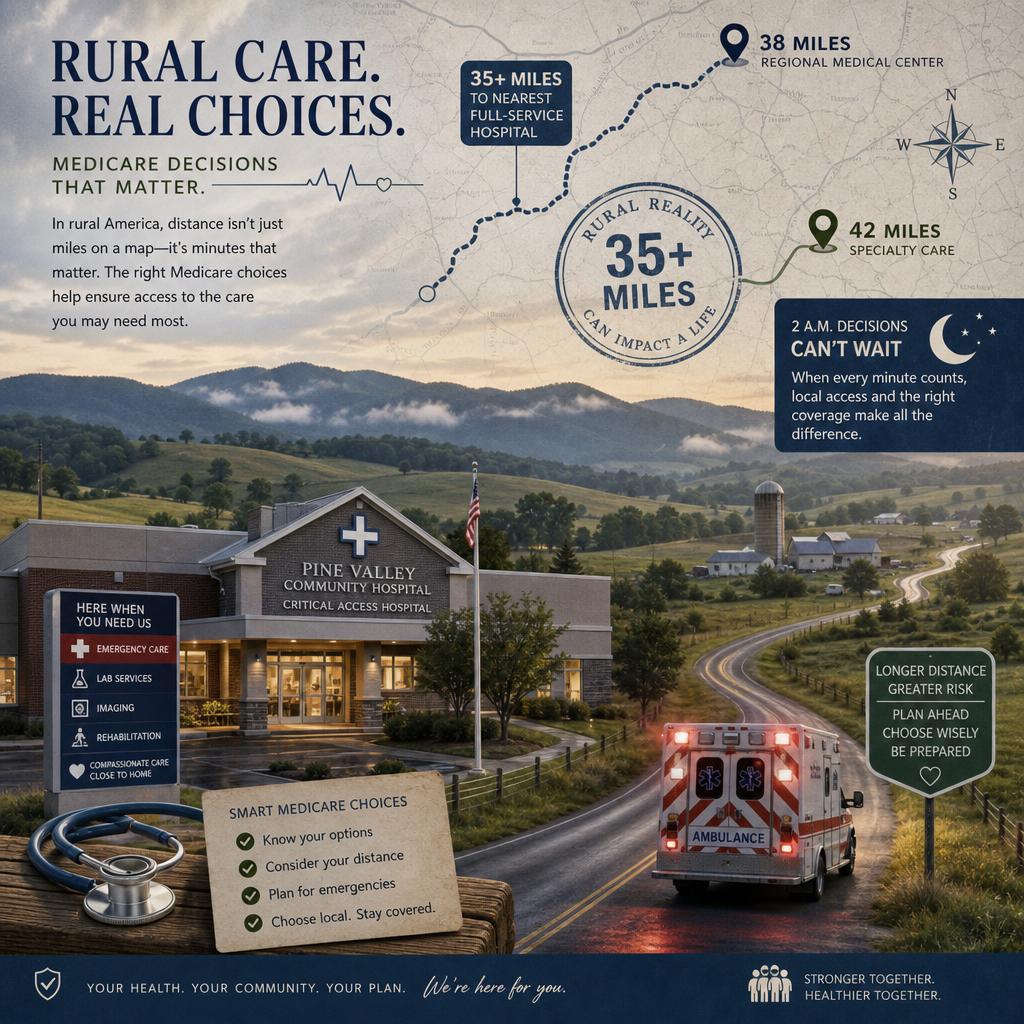
For many retirees in rural America, the most important Medicare decision is not made in a glossy benefits chart. It is made at 2 a.m., when a spouse has chest pain, the ambulance heads toward the nearest facility, and the family discovers that the words hospital, emergency, inpatient, observation, and network do not always mean what they assumed.
A critical access hospital is not simply a smaller version of a city hospital. Medicare defines it as a small rural facility located a significant distance from another hospital or critical access hospital, generally more than 35 miles, or 15 miles in mountainous terrain or areas with only secondary roads. It provides 24/7 emergency care, has 25 or fewer inpatient beds, and maintains an average acute care stay of 96 hours or less . That definition matters because it shapes the real-world Medicare questions families should ask before 2026 coverage begins.
Why A Critical Access Hospital Changes The Medicare Conversation
Original Medicare covers inpatient care received in acute care hospitals and critical access hospitals, along with inpatient rehabilitation facilities, long-term care hospitals, psychiatric inpatient facilities, and certain clinical research study care . On paper, that may sound reassuring. In practice, the coverage path can still turn on whether the patient is formally admitted as an inpatient, kept under observation, transferred, or treated and released.
This is where rural care becomes especially delicate. A critical access hospital may stabilize a patient and arrange transfer to a larger facility if specialized services are needed. Medicare may cover the hospital services themselves, but the family still has to understand which part of Medicare is paying, whether physician services are billed separately, and whether the next facility is appropriate under the plan’s rules. If the beneficiary has Original Medicare, Part B generally covers 80 percent of the Medicare-approved amount for doctors’ services received while in the hospital, separate from the Part A hospital framework .
The Ambulance Rule That Rural Families Should Not Guess At
The ambulance decision is often the first financial fork in the road. Medicare covers ground ambulance transportation to a hospital, critical access hospital, rural emergency hospital, or skilled nursing facility when medically necessary services are needed and travel by another vehicle could endanger the patient’s health . Medicare may also cover air ambulance transportation when immediate and rapid transport is required and ground transportation cannot provide it .
The insider detail is that Medicare covers transportation only to the nearest appropriate medical facility that can provide the needed care . A family may prefer a larger hospital 70 miles away because their specialist practices there, but coverage may be evaluated differently if a nearer critical access hospital could provide appropriate initial treatment. Under Original Medicare, the beneficiary generally pays 20 percent of the Medicare-approved amount for covered ambulance services, and the Part B deductible applies . Under Medicare Advantage, the same emergency medical necessity principles matter, but plan rules, network structure, and post-stabilization coordination can add another layer.
Observation Status Can Reshape The Bill After The Emergency
A rural hospital stay can feel like an admission even when Medicare does not treat it as one. Medicare says a person is an inpatient only when the hospital formally admits them with a doctor’s order. A patient receiving emergency services, observation services, lab tests, X-rays, or even an overnight hospital stay may still be considered an outpatient without that formal inpatient admission .
That distinction can affect what the patient pays and whether later skilled nursing facility coverage is available. If observation services last more than 24 hours, the hospital must provide the Medicare Outpatient Observation Notice, often called the MOON, explaining why the patient is considered an outpatient and how that status affects hospital costs and care after leaving the hospital . In a rural setting, where transfers and short stays are common, families should ask every day, clearly and calmly, whether the patient is inpatient or outpatient.
Original Medicare Versus Medicare Advantage In A Rural Service Area
Original Medicare usually allows beneficiaries to use any Medicare-enrolled doctor, hospital, or facility that accepts Medicare patients anywhere in the United States . That flexibility can be meaningful for people who live near county lines, travel to regional medical centers, or rely on rotating specialists who serve rural hospitals only on certain days.
Medicare Advantage works differently. Plans must cover medically necessary services that Original Medicare covers, but beneficiaries may need to use providers in the plan’s network and service area for non-emergency care, may need referrals, and may need prior authorization for certain services or supplies . Medicare Advantage plans also have yearly out-of-pocket limits for covered Medicare services, while Original Medicare has no yearly out-of-pocket limit unless the beneficiary has supplemental coverage such as Medigap, Medicaid, employer, retiree, or union coverage . For a rural household, the issue is not whether one model is always better. The issue is whether the chosen model fits the actual hospitals, specialists, ambulance routes, and referral patterns the family is likely to use.
The 2026 Plan Review Should Start With A Map Not A Premium
The annual review period for 2026 coverage begins with comparison activity on October 1, 2025, and the Medicare Open Enrollment Period runs from October 15 through December 7, 2025. Changes made during that period generally begin January 1, 2026 . For rural beneficiaries, that review should begin with geography, not advertising.
Before choosing a plan, identify the nearest critical access hospital, the nearest full-service regional hospital, the ambulance providers commonly used in the area, and the specialists most likely to be involved in a serious event. Then confirm how each plan treats those providers, what happens after emergency stabilization, and whether the physicians who practice inside the hospital are treated the same way as the facility itself. A low premium can be attractive, but it is not a substitute for access when a rural emergency becomes a transfer, an observation stay, or a specialist referral.
Medicare planning in 2026 is not just enrollment paperwork. It is a practical risk assessment for the places where care will actually happen. Vista Mutual helps clients compare Medicare Advantage, Medicare Supplement, and Part D choices through that real-world lens, including rural access, provider relationships, drug coverage, and out-of-pocket exposure. For help building a Medicare strategy that reflects your doctors, your hospitals, and your life, Schedule your 2026 Medicare consultation.