Long Term Care Hospitals And Medicare In 2026 The Transfer Decision Families Often Misread
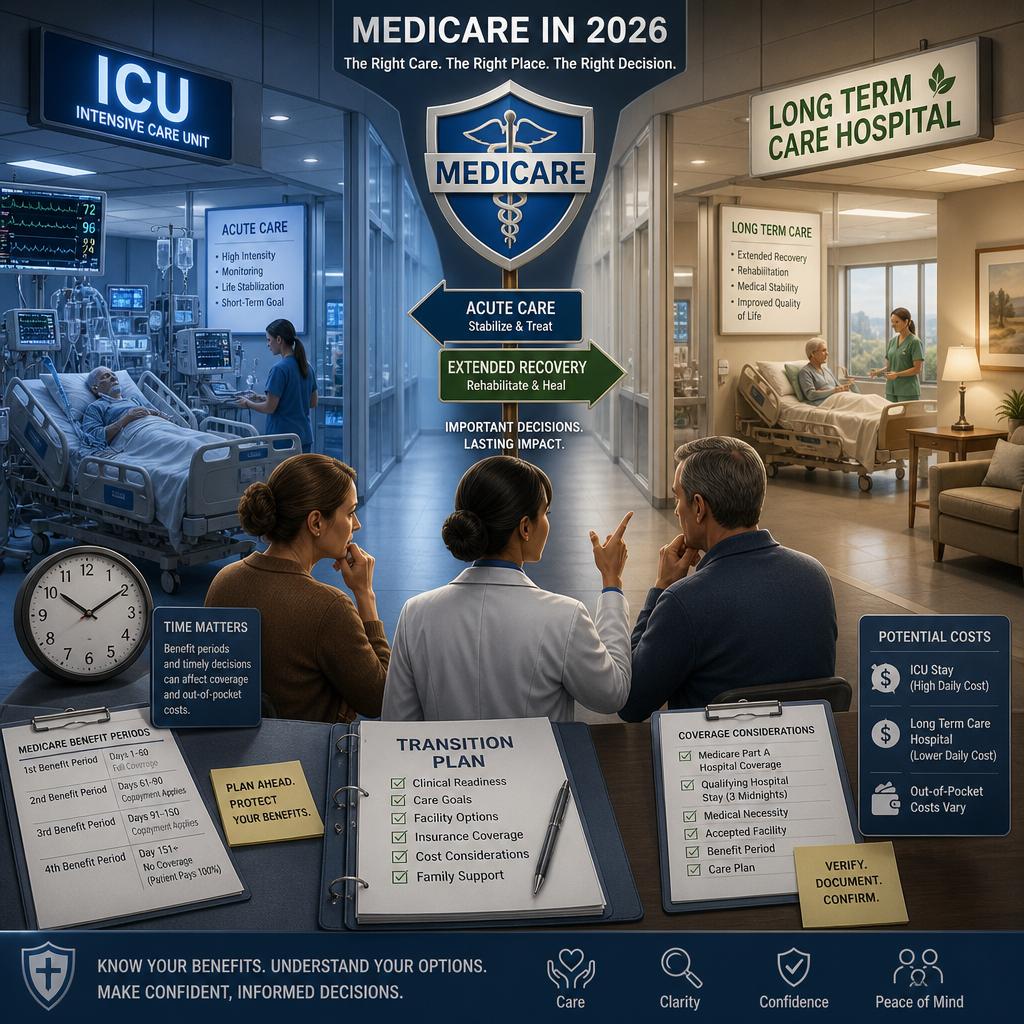
A serious hospital stay rarely ends with one clean decision. A spouse may hear that the intensive care team is recommending a transfer to a long term care hospital, often called an LTCH, and assume Medicare is now paying for long term care. The phrase sounds reassuring. It also sounds dangerously close to something Medicare usually does not cover.
That distinction matters in 2026 because Medicare does cover care in long term care hospitals when the patient meets inpatient hospital coverage rules, but Medicare does not cover non medical long term care, such as help with bathing, dressing, bathroom use, meal support, or supervision in a nursing home or community setting. The 2026 Medicare handbook identifies long term care hospitals as acute care hospitals that treat patients who stay, on average, more than 25 days, usually after transfer from an intensive or critical care unit . That is a medical setting, not a custodial care benefit.
The Name Creates The First Coverage Mistake
Imagine a 74 year old Medicare beneficiary recovering from sepsis, respiratory failure, and a prolonged ICU stay. The hospital says she is not ready for home, but she no longer needs the full resources of the ICU. Her family hears “long term care hospital” and begins thinking about nursing home planning, Medicaid spend down, and private pay room rates. In reality, the proposed LTCH may be part of her covered inpatient hospital path under Medicare Part A if the medical criteria are met.
The 2026 handbook lists long term care hospitals alongside acute care hospitals, critical access hospitals, inpatient rehabilitation facilities, inpatient psychiatric facilities, and qualifying inpatient clinical research study care as settings Medicare may cover for inpatient hospital care . It also explains that inpatient hospital services can include semi private rooms, meals, general nursing, certain drugs, and other services and supplies that are part of inpatient treatment, while excluding private duty nursing, personal comfort items, and a private room unless medically necessary . The practical lesson is simple but often missed: the setting may be covered because it is hospital level care, not because Medicare has suddenly become a long term custodial care program.
Benefit Periods Matter More Than Calendar Years
Families often ask the wrong first question. They ask whether Medicare will cover the LTCH. A sharper question is whether the patient is still in the same Part A benefit period, how many hospital days have already been used, and whether lifetime reserve days could come into play if the stay becomes prolonged.
Original Medicare measures inpatient hospital and skilled nursing facility use by benefit periods, not by neat January through December calendar years. A benefit period begins when a person is admitted as an inpatient in a hospital or skilled nursing facility and ends only after the person has not received inpatient hospital care or skilled care in a skilled nursing facility for 60 days in a row. If the patient returns after one benefit period has ended, a new benefit period begins, and the inpatient hospital deductible applies again. Medicare’s definition also makes clear there is no limit to the number of benefit periods .
That structure can surprise families when a patient has multiple serious episodes in one year. One discharge home, one readmission, and one LTCH transfer can feel like a continuous medical crisis, but Medicare accounting may treat later care differently if the 60 day break rule has been satisfied. Conversely, a hospital to LTCH transfer may stay inside the same benefit period, which changes how costs are analyzed. This is where a broker who understands both Medicare rules and plan design becomes valuable, because the brochure answer rarely captures the actual sequence of admissions, transfers, and discharge dates.
Original Medicare And Medicare Advantage Do Not Feel The Same At The Bedside
With Original Medicare, the central questions tend to involve inpatient status, medical necessity, benefit periods, assignment, and whether the beneficiary has Medigap or another secondary payer. Original Medicare generally allows access to any Medicare enrolled doctor, provider, or hospital that accepts Medicare patients anywhere in the United States, while Part B covered physician services are typically subject to the Part B deductible and 20 percent coinsurance if the provider accepts assignment .
Medicare Advantage works differently at the point of transfer. The plan must cover medically necessary services covered by Original Medicare, but the beneficiary may need to use network providers, may need referrals, and may need prior authorization before certain services or supplies are covered . For a family in the hospital discharge window, that can mean the medically preferred LTCH is not the financially preferred LTCH, or that the transfer requires a plan approval before the move occurs.
This is one of the highest stakes differences between “covered” and “approved.” The hospital physician may believe LTCH care is appropriate. The discharge planner may know which facility has a bed. The Medicare Advantage plan may still apply its own network and authorization rules. The 2026 handbook also notes that plan out of pocket costs depend on whether the beneficiary uses network providers, whether the plan covers out of network care, whether prior authorization applies, and the plan’s annual limit for Part A and Part B covered services . In a long hospital recovery, those details can be more important than the premium that looked attractive in October.
The Custodial Care Boundary Returns At Discharge
The LTCH decision is not only about admission. It is also about what happens after the patient stabilizes. Medicare may pay for medically necessary inpatient hospital care, but when the patient no longer needs that level of medical treatment, the coverage conversation changes quickly.
The 2026 handbook is explicit that Medicare and most health insurance, including Medigap, do not pay for non medical long term care services in a nursing home or community setting. That includes personal care assistance with everyday activities such as dressing, bathing, and using the bathroom, and it may also include adult day health care, transportation, home delivered meals, and other home and community based services . A patient can move from a covered LTCH stay to a discharge plan that exposes a family to private pay custodial care almost overnight.
This is why the discharge meeting should not be treated as paperwork. It should be treated as a coverage audit. Is the next setting skilled nursing, inpatient rehabilitation, home health, custodial care, hospice, or outpatient follow up? Is the patient being discharged because the medical level of care has changed, or because the plan has denied additional days? Is the family being asked to sign notices that shift financial responsibility? A rushed signature can become the most expensive document in the room.
Prescription Costs Can Still Shape The Recovery Plan
Hospital and facility coverage usually dominate the conversation, but medication planning should not be an afterthought. A patient leaving LTCH care may have new inhalers, anticoagulants, antibiotics, insulin, transplant drugs, pain medications, or specialist prescribed therapies. In 2026, Part D out of pocket costs for covered drugs are capped at $2,100 for the calendar year, after which the beneficiary pays no copayment or coinsurance for covered Part D drugs for the rest of the year .
That cap is meaningful, but it does not make formularies irrelevant. A drug still has to be covered by the plan, placed on a tier, available through an appropriate pharmacy, and not blocked by rules such as prior authorization, quantity limits, or step therapy. Medicare’s 2026 materials remind beneficiaries that drug costs vary by formulary, tier, benefit phase, pharmacy choice, and eligibility for Extra Help . After a major hospitalization, the wrong Part D or Medicare Advantage drug design can create friction precisely when adherence matters most.
The Questions To Ask Before A Transfer Is Accepted
Before agreeing to an LTCH transfer, the family should know the patient’s inpatient admission date, whether the stay is being counted under Part A, whether the LTCH is in network if the patient has Medicare Advantage, whether prior authorization has been granted, whether physician services will be billed separately under Part B, and what discharge setting is realistically expected after the LTCH stay. Those questions sound administrative, but they are clinical risk management in disguise.
This is the quiet complexity of Medicare in 2026. A long term care hospital can be exactly the right medical setting, yet the surrounding coverage rules can differ sharply depending on Original Medicare, Medigap, Medicare Advantage, Part D, Medicaid eligibility, and the patient’s recent benefit period history. Families should not have to decode those rules while standing in a hospital hallway.
Vista Mutual helps clients think several moves ahead, before a crisis turns plan design into a bedside problem. If your 2026 Medicare choices need to account for serious illness, hospital transfers, rehabilitation risk, prescription exposure, or the possibility of future facility care, Consult with the Vista Mutual team. The right guidance cannot remove every uncertainty, but it can replace guesswork with a plan you understand before the next decision is urgent.