Medicare Hospital Price Transparency In 2026 Why A Posted Charge Is Not Your Final Bill
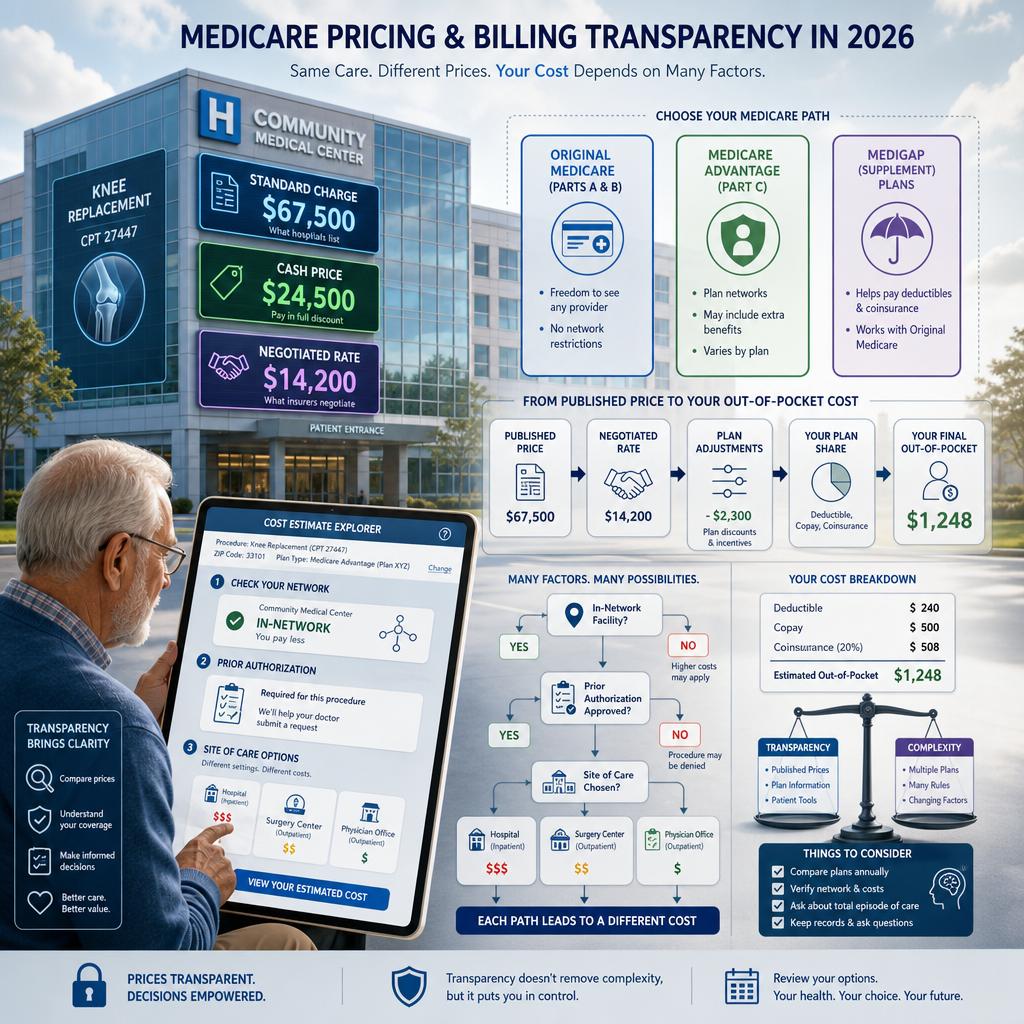
A hospital website can look like it is finally giving Medicare beneficiaries the answer they have wanted for years: what will this cost? In 2026, that answer is more available than it used to be, but it is still not as simple as a posted dollar figure. A beneficiary comparing outpatient testing, same day procedures, or hospital based specialist care may see a standard charge, a cash price, and negotiated amounts, then assume the lowest number tells the whole story. It does not.
Medicare billing is not retail shopping. The same service can move through Original Medicare, a Medicare Supplement, a Medicare Advantage HMO, a Medicare Advantage PPO, a hospital outpatient department, or an independent physician office with very different consequences. The 2026 Medicare handbook notes that hospitals are now required to share standard charges for their items and services, including standard charges negotiated by Medicare Advantage Plans, on their websites to help patients make more informed decisions about care . That is progress, but it is not a substitute for plan level interpretation.
The Posted Hospital Price Is Only The Beginning
Consider a retired couple in 2026, both on Medicare, both using the same hospital system. One spouse has Original Medicare with a Medigap policy. The other has a Medicare Advantage PPO. They both need the same outpatient cardiac test at the same hospital. The hospital may publish a standard charge for the test and may also publish negotiated rates tied to specific Medicare Advantage contracts. Yet the couple’s actual bills may still look nothing alike because Medicare payment rules do not begin and end with the hospital’s posted price.
Under Original Medicare, Part B generally pays its share of covered outpatient services after any applicable deductible, and the beneficiary typically owes 20 percent of the Medicare approved amount when the provider accepts assignment. The handbook is careful to note that Original Medicare has no yearly out of pocket limit unless the beneficiary has other coverage, such as Medigap, Medicaid, employer, retiree, or union coverage . A posted hospital charge may be far higher than the Medicare approved amount, but the beneficiary still needs to know whether the service is covered, whether assignment applies, whether a hospital outpatient copayment is involved, and whether supplemental coverage will absorb some or all of the remaining share.
Medicare Advantage Adds A Second Layer Of Interpretation
Medicare Advantage can make price transparency both more useful and more misleading. It is useful because the posted file may show negotiated rates with specific plans. It is misleading because the negotiated rate is not automatically the member’s copayment, coinsurance, or maximum exposure. Medicare Advantage Plans have their own cost sharing, network rules, prior authorization requirements, referrals in some cases, and annual out of pocket limits for covered Part A and Part B services .
This is where many beneficiaries misread the value of a posted hospital price. If a Medicare Advantage member sees that Hospital A has a lower negotiated rate than Hospital B, that does not necessarily mean Hospital A is cheaper for the member. The plan may assign the same copayment for a category of outpatient services regardless of the hospital’s internal negotiated amount. Or the lower priced facility may be out of network, which can increase the member’s cost or lead to noncoverage for non-emergency care. Medicare specifically warns that if a beneficiary in a Medicare Advantage Plan uses a provider outside the plan’s network for non-emergency or non-urgent care, the plan may not cover the service or costs may be higher .
The Site Of Care Can Change The Bill Without Changing The Service
One of the most overlooked Medicare planning issues is that the medical service and the billing setting are not always the same thing. A test performed in a hospital outpatient department may be clinically identical to a test performed in a freestanding office, but the Medicare cost structure can be different. The handbook explains that outpatient hospital services may cost more than the same care in a doctor’s office because, in addition to the doctor’s or provider’s charge, the beneficiary usually pays the hospital a copayment for each service received in a hospital outpatient setting, except for certain preventive services .
That distinction can surprise people who did everything right medically. They used an in-network hospital, followed the doctor’s order, and received a covered service. The unexpected bill arrives because the hospital outpatient department triggered a facility related charge, or because the plan classifies the service differently than the patient expected. Price transparency may show the hospital’s standard charge, but it may not clearly translate the patient’s specific benefit design into a final responsibility.
Why The Cash Price Can Be A Trap For Medicare Beneficiaries
A hospital’s posted cash price may be tempting, especially when it appears lower than the billed charge. But Medicare beneficiaries should be careful before choosing to bypass insurance. Paying cash can affect whether the amount counts toward a deductible, an out of pocket maximum, or a Part D prescription drug cap. It can also create problems if the service later needs to connect to related claims, appeals, medical necessity documentation, or follow up care.
For prescription drugs, the 2026 rules make this distinction especially important. Medicare drug coverage caps yearly out of pocket spending for covered Part D drugs at $2,100 in 2026, after which the beneficiary owes no copayment or coinsurance for covered Part D drugs for the rest of the calendar year . But that protection is tied to covered Part D drugs and plan processing. A beneficiary who repeatedly chooses non-plan cash channels without understanding the consequences may lose the practical value of having claims tracked inside the benefit structure.
A Smarter 2026 Price Check Uses Medicare Rules First
The high value move in 2026 is not to ignore hospital prices. It is to read them in the right order. Before a beneficiary treats a hospital posted charge as actionable, the first question should be whether the service is covered under the person’s current Medicare arrangement. The second question is whether the provider, facility, and supplier are properly participating or in network. The third question is whether the care requires prior authorization, a referral, an organization determination, or a different site of service to avoid unnecessary cost.
If there is one practical checklist worth using, it is this: confirm the billing location, confirm network status, confirm whether prior authorization is required, ask whether the same service can be performed in a lower cost setting, and request the plan specific patient responsibility before the appointment whenever possible. That last step matters because Medicare Advantage members can ask for an organization determination in advance to find out whether a service, drug, or supply is covered and how much they may have to pay .
The Broker’s Role Is Translating Price Into Risk
The reason hospital price transparency does not eliminate the need for professional Medicare guidance is that prices are only one layer of the decision. A low premium Medicare Advantage Plan may have attractive negotiated rates but a narrow network. Original Medicare may offer broad provider access, but without supplemental coverage it has no annual out of pocket ceiling for Part A and Part B services. A Medigap policy may reduce exposure, but it has its own premium and enrollment rules. Each option can be rational for the right person and dangerous for the wrong one.
This is where Vista Mutual’s work becomes practical rather than theoretical. A good Medicare review does not simply compare premiums. It tests how your doctors, hospitals, prescriptions, travel patterns, chronic conditions, and likely procedures will behave under each coverage structure. The 2026 Medicare environment gives beneficiaries more information than ever, but more information can also create more room for misinterpretation.
A posted hospital price can help you ask better questions. It cannot tell you whether a Medicare Advantage referral rule will apply, whether a facility is preferred, whether a Medigap policy would protect you more effectively, or whether your drug spending should be managed through plan benefits rather than cash workarounds. For that, you need a guided review that connects the public price to the private reality of your coverage.
Peace of mind in Medicare does not come from finding one number on a hospital website. It comes from knowing how that number will move through your actual plan before care begins. If you want help interpreting 2026 plan choices with that level of precision, Schedule your 2026 Medicare consultation with the Vista Mutual team.