Meeting Medicare Skilled Nursing Facility Eligibility in 2026
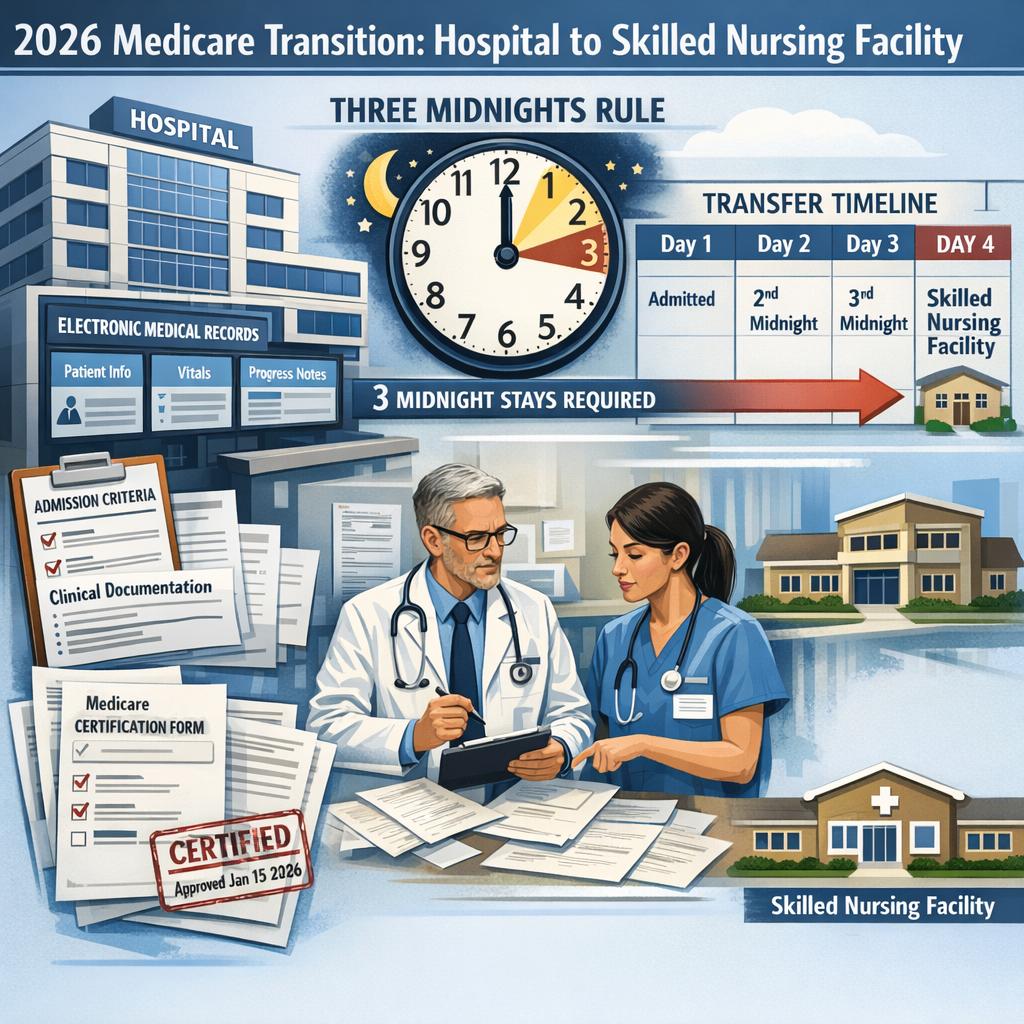
Picture this: Your mother has emergency surgery for a hip fracture, spends four tense days in an acute care hospital, and now needs weeks of rehabilitation. It is the classic scenario where Medicare promises to help, but for decades, confusion surrounded when and how skilled nursing facility (SNF) coverage truly applies. For 2026, new federal guidelines raise the bar on clinical documentation and hospital record continuity required to unlock these coveted benefits—moving away from past ambiguity and administrative loopholes.
Failure to meet specific, often lesser-known requirements can saddle families with thousands in unexpected bills. With strict protocols now in daily effect, expert guidance is essential to safeguard post-acute care success, fiscal security, and peace of mind under Medicare rules in the modern era.
2026 SNF Trigger Rules The Three Midnight Minimum Recast with Documentation Precision
The 2026 update centers around additional Medicare scrutiny of the so-called qualifying inpatient stay—the canonical "three midnights" rule. SNF coverage begins only for beneficiaries admitted "as inpatients" to a hospital for at least three consecutive midnights, not just days on the calendar, and now mandates that every moment is documented as medically necessary admission. Stays in observation status, no matter how long or how intensive, do not count toward the three midnights. In other words, if even one night is filed as observation (under Part B billing), the eligibility clock restarts.
Modern hospital workflows are increasingly convoluted: transfers between acute floors, surgical step downs, and quick obs-to-inpatient bounce-overs fuel beneficiary confusion. In 2026, CMS directs case managers and hospitals to issue detailed written certifications for every qualifying admission, with no tolerance for clerical backdating—a new electronic claims review process triggers audits and coverage denials when stays are miscoded. Classic scenarios go off the rails when patients, expected to enter SNF post-op, are “caught out” by a missed inpatient status order in the first nightly chart or when transfers cross hospital locations and key forms lag by even one calendar day.
Once three bona fide midnights are sector-logged, Medicare authorizes robust coverage: up to 100 days in a participating SNF, fully paid for the first 20 days (regardless of income), and after that, a $204 daily coinsurance (2026 rate) through day 100. Coinsurance ceases after day 100, and all continued SNF use turns self-pay unless other policies (Medigap, Medicaid or LTC insurance) pick up exposure. Many Advantage plans will introduce varied cost-sharing this year, sometimes with alternative care networks or preferred facility panels that require pre-enrollment or regional allocation—a shift from prior “any willing provider” selection. Regardless, entry revolves around evidence-driven DRG-to-routed documentation of acute episode, needs for daily skilled therapy, and real potential for improvement in function/health status as justified against the discharge summary.[d0]
Point of Breakdown: When Coverage is Lost or Limited by Rule Nuance
Patient stories elucidate the complexity forward. William, 74, battered by pneumonia and weakness, lands three days at Regional Medical Center but on review, his admitting order is "observation – status for tests," so none count toward his SNF eligibility. Transferring later as a formal inpatient for only two nights, his post-discharge rehabilitation begins—daily SNF bills denied, as true 3-midnight compliance laps the threshold. Appeals that cite "severity of illness" cannot reverse mandatory checklist shortfalls under CMS’s 2026 rules.
Meanwhile, Theresa is correctly inpatient all three midnights after elective spine surgery but finds that her local “preferred” SNF is booked for five days. The hospital discharges her home—with clearly filed provider orders for skilled entry—yet because she goes seven days between discharge and SNF admission, her qualification lapses. New requirements lock all Medicare SNF transitions to no more than thirty calendar days post-hospital, preferably less as is coded into HER claims. Maximizing this clock relies on hospital discharge planners, social work, and a proactive insurance advocate to track dates, status transitions, and certification validity across multiple provider systems.
Other crucial trap: skilled need notation. 2026 continues the policy that mere custodial/nonskilled needs never trigger SNF coverage. Physical therapy orders (“must improve ambulation from bed to commode”), daily IVs, complexity medications, or intensive wound care pass muster—routine med review, help with feeding/bathing, social placement lacks force unless routed via combined PT/OT/MD certification. Once the last daily skilled note ends—often in the chart by PTs or MDs three-day schedule—Medicare terminates coverage immediately, with claims recouped retroactively if checked post hoc.
Maximizing Coverage and Avoiding Gaps: Precision from Admission to Discharge
Only those prepared make the most of the evolving 2026 SNF pathways. Three fail-safes:
- Demand written physician order indicating inpatient status be placed, dated, and time stamped nightly starting day of admit (do not settle for EMR “future corrections” without addenda).
Lay in every OT, PT, and skilled RN visit within same EMR record. Each overlaps requirements for ‘reasonably expected benefit’ as acute episode connection backed by major changenotification corralling document ticket by discharge file.
Work with an experienced brokerage or case manager to navigate facility preferences, day counts, Medigap hand-ins, first and last dates for SNF, and plan network review before inpatient discharge signs; this is vital for transitioning appropriately and leveraging any relevant 2026 rule improvements over previous routine.
This attention holds multiplied value for high risk clients—especially those moving inter-state, switching between Advantage, or spending winters far from familiar hospital networks. Families frequently encounter snags over pre coding in plan year switches, or missed transfer document attachment after complex specialty double admits (trauma/surgery, medical/ICU). Annual plan network changes also force proactive checks of which local SNFs are staying in-network into 2026 or adjusting cost shares upwards—no step should occur without full advance documentation and advance-plan match-up.
Snags afflict both first timers (after fall injury, new vascular events, household disasters), and returning cases—once out of care, the window: for new skilled Medicare resets only with a fresh qualifying acute admit. To preserve future access and today’s dollars, maintain prompt hospital-SNF hand off, never delay care window chasing “room upgrades,” and consult agent/advocate well before hospital discharge scripts begin. Secure documented proof of qualifying stay, correctly coded, and have a claim navigation professional confirm the path with facility billing in live time.
Medicare’s upgraded SNF coverage remains valuable—but only for the diligent. Avoid preventable outcome loss by running the paperwork clock in step with true clinical need.
On this high-impact insurance crossroad, expert precision blocks thousands in denied benefits. Get ahead: schedule your 2026 Medicare consultation for a full walk through and scenario-driven advice, so every hospital and SNF day achieves maximum insurance leverage in the complex new Medicare year.