Prostate Cancer Screening And The Medicare Cost Split Men Miss In 2026
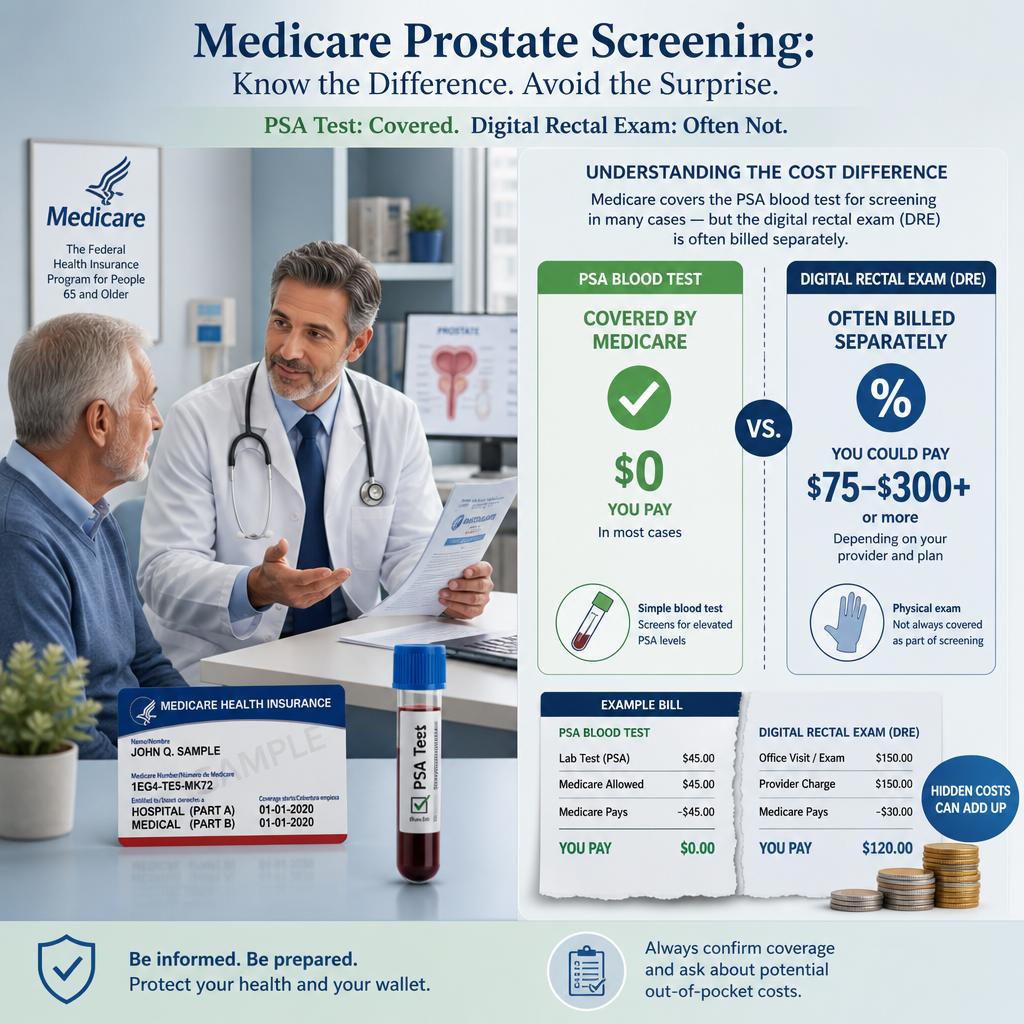
A man can do everything right in 2026, schedule his annual prostate cancer screening, follow his physician’s advice, and still leave with a bill he did not expect. That is because Medicare’s prostate screening benefit is not one single financial rule. It is two related services with different cost treatment, and the difference often becomes visible only after the claim is processed.
For many Medicare beneficiaries, prostate screening is discussed quickly during a primary care visit. The doctor orders a prostate specific antigen test, commonly called a PSA test, and may also perform a digital rectal exam. Both can be clinically appropriate. Yet under Medicare, the PSA test and the digital rectal exam do not land the same way on the beneficiary’s cost ledger. Medicare states that it covers prostate cancer screenings once every 12 months for men over 50, starting the day after the 50th birthday, but the PSA test costs nothing while the digital rectal exam can trigger 20 percent of the Medicare approved amount, the Part B deductible, and a hospital outpatient copayment if performed in that setting .
The Screening Benefit Is Simple Until The Claim Separates The Services
Consider Robert, age 68, who moved into Medicare after decades of employer coverage. His doctor says, “We will do your prostate screening today,” and Robert reasonably hears that as one preventive benefit. The lab draw for the PSA test may indeed be covered at no cost under Original Medicare. The exam performed in the room, however, is treated differently. That distinction is not a clerical technicality. It can determine whether the visit feels free, modestly priced, or unexpectedly expensive.
The reason this matters in 2026 is that Medicare beneficiaries are being encouraged to compare plans more actively, and many are weighing Original Medicare with a Supplement against Medicare Advantage plans with lower premiums and structured copays. Medicare’s own materials remind beneficiaries that Original Medicare generally lets them use any Medicare enrolled provider who accepts Medicare patients nationwide, but it does not have a yearly out of pocket limit unless the person has other coverage such as Medigap, Medicaid, employer, retiree, or union coverage . That means even small recurring distinctions, like the way a screening visit is coded, become part of a broader risk conversation.
Why The Location Of Care Can Change The Experience
One of the least appreciated Medicare planning questions is not only what service is covered, but where the service is delivered. A digital rectal exam performed in a physician office may generate a different cost experience than the same service delivered in a hospital outpatient department. Medicare’s prostate screening language specifically notes that for the digital rectal exam, a beneficiary may also pay a copayment in a hospital outpatient setting . For someone who assumed all preventive care was zero cost, that can feel like a breach of trust, even when the bill is technically correct.
This is where expert guidance becomes practical rather than theoretical. A beneficiary choosing a Medicare Advantage plan must look beyond the monthly premium and dental allowance. Medicare Advantage plans must cover medically necessary services Original Medicare covers, but they can have networks, prior authorization rules, plan specific copays, and different cost sharing structures. Medicare notes that many Medicare Advantage plans require use of network providers and may require prior authorization for certain services or drugs . A prostate screening itself may seem routine, but the surrounding visit, lab facility, specialist referral, or outpatient department billing can vary by plan design.
The One Question To Ask Before The Visit
Before a prostate screening appointment in 2026, the most useful question is not, “Does Medicare cover this?” The better question is, “Which parts of today’s visit will be billed as preventive screening, which parts may be billed as diagnostic or medical care, and will any part be billed through a hospital outpatient department?” That wording forces the provider’s office to think in the same categories Medicare uses when the claim is submitted.
Here is the only checklist most beneficiaries need before the appointment:
- Ask whether the PSA test, digital rectal exam, office visit, and any follow up discussion will be billed separately, and confirm whether the provider accepts assignment or participates in your Medicare Advantage network.
That single question can uncover several hidden issues at once. In Original Medicare, assignment matters because participating providers agree to accept the Medicare approved amount as payment in full, with the beneficiary responsible only for applicable deductible and coinsurance amounts. Medicare defines assignment as an agreement by the provider or supplier to be paid directly by Medicare, accept the Medicare approved amount, and not bill more than the deductible and coinsurance . In Medicare Advantage, the equivalent concern is whether the physician, lab, and facility are in network and whether the plan’s evidence of coverage treats the services differently.
When Screening Turns Into Diagnosis
The cleanest prostate screening claim is routine: a covered PSA test, no symptoms, no abnormal findings, and no additional medical evaluation. Real life is often less tidy. If a PSA result is elevated, if urinary symptoms are discussed, if the physician evaluates pain, infection, medication side effects, or prior cancer history, the visit can move from preventive screening into diagnostic care. That does not mean the care is wrong. It means the cost category may change.
Medicare’s broader preventive service rule is important here. It says beneficiaries pay nothing for most covered preventive services when the provider accepts assignment, but deductible or coinsurance can apply for some preventive services, and those costs may also apply if a preventive service occurs in the same visit as a non preventive service . In plain English, the free portion of the visit may remain free, while the medical evaluation attached to it may not. This is one of the most common places where beneficiaries feel blindsided, because the appointment was scheduled as preventive but documented partly as diagnostic.
Original Medicare Medigap And Medicare Advantage Can Produce Different Outcomes
For a beneficiary with Original Medicare alone, a digital rectal exam’s cost sharing may be manageable in isolation but still part of an uncapped exposure pattern. Original Medicare generally applies deductibles and coinsurance to many Part B services, and without supplemental coverage there is no annual ceiling on what a person pays out of pocket for covered services . A Medigap policy can soften that exposure, depending on the standardized plan, but eligibility rules, timing, and underwriting can be consequential.
For a beneficiary in Medicare Advantage, the analysis changes. The plan has an annual out of pocket limit for Part A and Part B covered services, and once that limit is reached, covered Part A and Part B services cost nothing for the rest of the year . That protection is meaningful, but it does not erase the need to check provider networks, outpatient facility costs, lab arrangements, and referral patterns. A low premium plan can be excellent for one man’s care pattern and frustrating for another’s if his urologist, preferred hospital outpatient department, or lab is outside the plan’s strongest network.
Why This Small Benefit Belongs In A Serious 2026 Plan Review
Prostate screening is not the largest Medicare expense most men will face in 2026. That is precisely why it is such a useful test of whether a Medicare plan has been chosen thoughtfully. If a plan review cannot explain the cost difference between a PSA test and a digital rectal exam, it is unlikely to fully explain oncology drugs, outpatient imaging, specialist networks, hospital observation billing, or post acute care decisions.
At Vista Mutual Insurance Services, we look at Medicare the way beneficiaries experience it: through real appointments, real claims, real doctors, and real pharmacy counters. A prostate screening visit may be routine medicine, but the coverage rules behind it are a reminder that Medicare is not one card with one answer. If you want a 2026 plan strategy that accounts for the details before they become bills, Schedule your 2026 Medicare consultation with the Vista Mutual team.