Rural Emergency Hospitals And Medicare Network Decisions In 2026
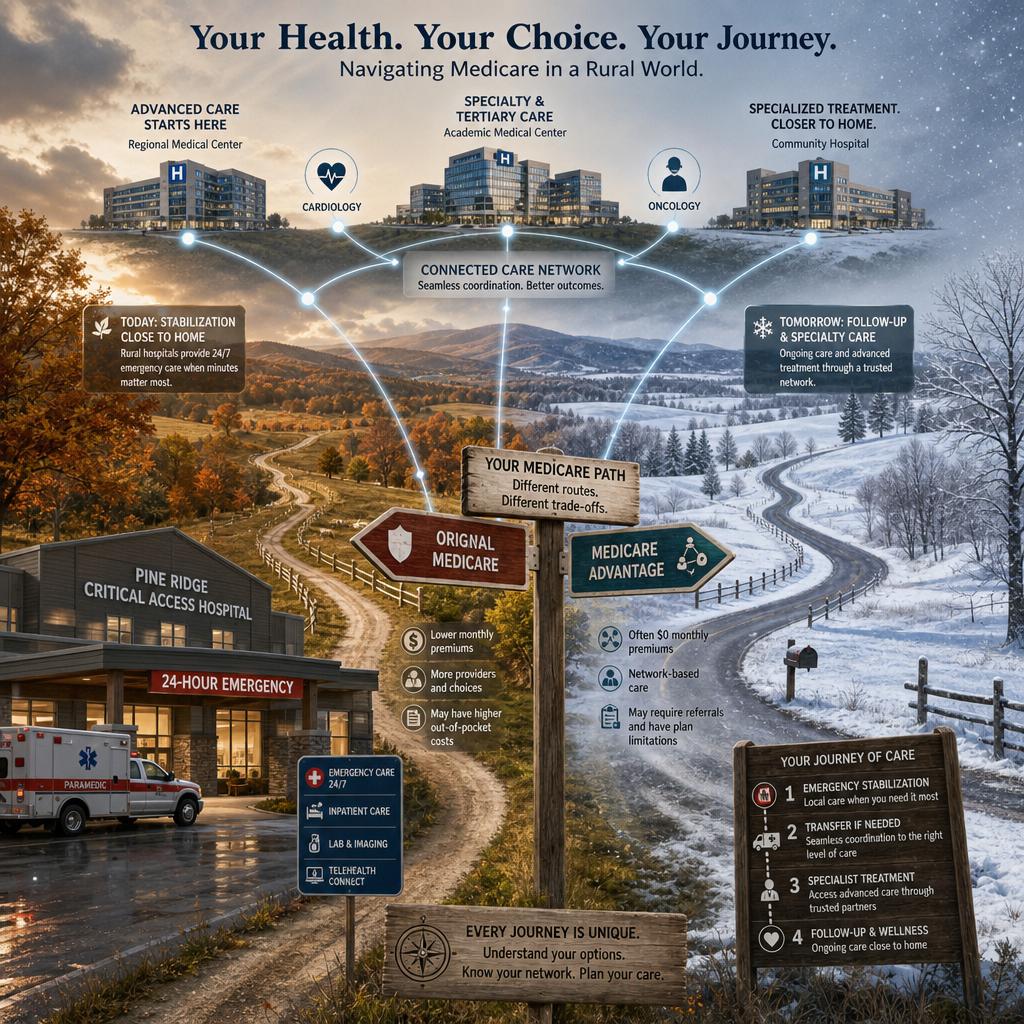
A retired couple in a rural county can make a Medicare decision that looks sensible in October and feels very different in February. The plan premium is low, the dental allowance looks useful, and the pharmacy list seems manageable. Then one spouse develops chest pain on a Sunday evening, the ambulance goes to the nearest small hospital, and the family discovers that Medicare coverage is not only about what is covered. It is also about where care begins, which providers participate, how transfers are handled, and whether follow-up specialists are realistically accessible.
That is why rural emergency access deserves a dedicated 2026 Medicare conversation. Medicare materials rightly explain the broad choice between Original Medicare and Medicare Advantage, but rural beneficiaries often live in the gray space between policy design and geography. Original Medicare generally lets you use any Medicare-enrolled doctor or hospital that accepts Medicare patients anywhere in the United States, while Medicare Advantage plans may require network providers for non-emergency care and may charge more, or deny coverage, when non-emergency care occurs outside the plan’s rules . In rural areas, that difference can become more important than a monthly premium.
The Rural Hospital Is Not Just A Smaller Hospital
Medicare defines a critical access hospital as a small rural facility that is generally more than 35 miles from another hospital, or 15 miles in certain mountainous or secondary-road areas, provides 24 hour emergency care, has 25 or fewer inpatient beds, and maintains an average acute-care stay of 96 hours or less . That definition matters because many rural hospitals are built for stabilization, short stays, emergency evaluation, and transfer decisions, not for every specialized service a beneficiary may need.
For a Medicare beneficiary, the first bill may not be the only issue. The more consequential question is what happens after the emergency physician says, “We need cardiology,” “We need a higher-level stroke center,” or “You need follow-up imaging next week.” The first facility may accept Medicare, but the next provider may be outside a Medicare Advantage network. Original Medicare’s national access model can be valuable in this setting because it generally does not require referrals for specialists and permits care from Medicare-enrolled providers who accept Medicare patients across the country .
Emergency Coverage Does Not Solve The Follow Up Problem
Many people assume that because emergency care is protected, the plan choice is less important. That assumption is incomplete. Emergency treatment is only the beginning of the care episode. After discharge, a rural patient may need a hospital-based specialist, durable medical equipment, home health services, rehabilitation, infusion therapy, or prescription changes. Medicare Advantage plans must cover medically necessary services that Original Medicare covers, but the plan may use provider networks and may require prior authorization for certain services or supplies .
This is where rural Medicare planning becomes highly personal. A plan can look strong on paper and still create friction if the county has few in-network specialists, if the preferred hospital system is across a state line, or if the nearest high-quality rehabilitation option is not contracted. Medicare’s own plan comparison framework notes that Medicare Advantage costs can vary based on whether care comes from network providers or from providers that do not contract with the plan, and non-emergency or non-urgent out-of-network care may be uncovered or more expensive . For a rural beneficiary, the difference between “covered” and “usable” can be a two-hour drive.
The 2026 Drug Cap Helps, But It Does Not Replace Network Planning
The 2026 Part D out-of-pocket cap is an important improvement. For covered Part D drugs, annual out-of-pocket costs are capped at $2,100 in 2026, and once that cap is reached, the beneficiary pays no copayment or coinsurance for covered Part D drugs for the rest of the calendar year . For rural patients managing heart failure, diabetes, cancer, autoimmune disease, or post-hospital medication changes, that cap may reduce the fear of runaway pharmacy spending.
Still, the cap applies to covered Part D drugs, not every medical cost created by a rural emergency. It does not make an out-of-network specialist in network. It does not remove prior authorization for a plan-covered service. It does not pay for a non-covered drug, a pharmacy that is not preferred, or a service classified under Part B rather than Part D. Medicare also notes that actual drug costs still depend on the formulary, tier, benefit phase, pharmacy choice, and whether the beneficiary receives Extra Help . In other words, the 2026 cap is meaningful protection, but it is not a substitute for plan-level analysis.
Original Medicare And Medicare Advantage Create Different Rural Risk Profiles
Original Medicare and Medicare Advantage are both legitimate paths, but they manage rural risk differently. Original Medicare typically offers broader provider access, but it has no yearly out-of-pocket limit unless the beneficiary has other coverage such as Medigap, Medicaid, employer coverage, retiree coverage, or union coverage . Medicare Advantage plans, by contrast, have a yearly limit on what beneficiaries pay for covered Medicare services, and once that plan limit is reached, covered services cost nothing for the rest of the year .
That tradeoff is not academic. A beneficiary with Original Medicare and a strong Medicare Supplement may prioritize broad access to distant specialists and hospitals. A beneficiary in a well-built Medicare Advantage plan may value coordinated benefits, an out-of-pocket maximum, embedded drug coverage, and extra services. The mistake is choosing either route based on one feature alone. In rural communities, the correct analysis often starts with the real care map: the local hospital, the likely transfer hospital, the oncology group, the cardiology practice, the orthopedic clinic, the home health agency, the preferred pharmacy, and the family members who can realistically drive.
The Questions A Rural Beneficiary Should Ask Before 2026 Enrollment
A polished brochure rarely tells the whole rural story. Before choosing a 2026 plan, beneficiaries should test the coverage against the care they would actually use. The most revealing questions are often these:
- Is my nearest hospital in network for non-emergency follow-up, outpatient testing, and affiliated specialists?
- If I am transferred to a larger hospital, are the hospital and specialist groups in network?
- Does the plan require referrals or prior authorization for imaging, rehabilitation, home health, durable medical equipment, or specialist care?
- Are my prescriptions covered under the plan formulary, and do my local pharmacies have preferred cost sharing?
- If I travel to another county or state for routine care, will the plan treat that care as in network, out of network, or not covered except in emergencies?
These questions are not meant to make Medicare feel intimidating. They are meant to prevent a familiar rural problem: discovering the rules only after the ambulance ride, transfer, discharge order, or specialist referral has already occurred. Medicare beneficiaries are asked to compare coverage each year, and Medicare emphasizes that plan coverage, costs, provider networks, service areas, and drug formularies can change for the coming year . In 2026, that annual review is especially important for anyone whose health care depends on a small hospital ecosystem.
Professional Guidance Turns Geography Into A Plan Strategy
The most expensive Medicare decision is not always the plan with the highest premium. Sometimes it is the plan that fails quietly at the moment care becomes complex. Rural beneficiaries need more than a premium comparison. They need a stress test of how their coverage will behave when the closest emergency department stabilizes them, when the next hospital is outside the county, and when recovery depends on specialists, pharmacies, and post-acute providers.
Vista Mutual Insurance Services helps clients compare Medicare Advantage, Medicare Supplement, and Part D options through that practical lens. The goal is not to sell fear. It is to replace uncertainty with a plan that reflects your doctors, your hospital patterns, your prescriptions, your travel habits, and your tolerance for network rules. If you want a 2026 Medicare review that looks beyond the brochure and into how care actually happens where you live, Consult with the Vista Mutual team.