The 2026 Medicare Accident Claim Coordination Trap Retirees Should Understand Before Settlement
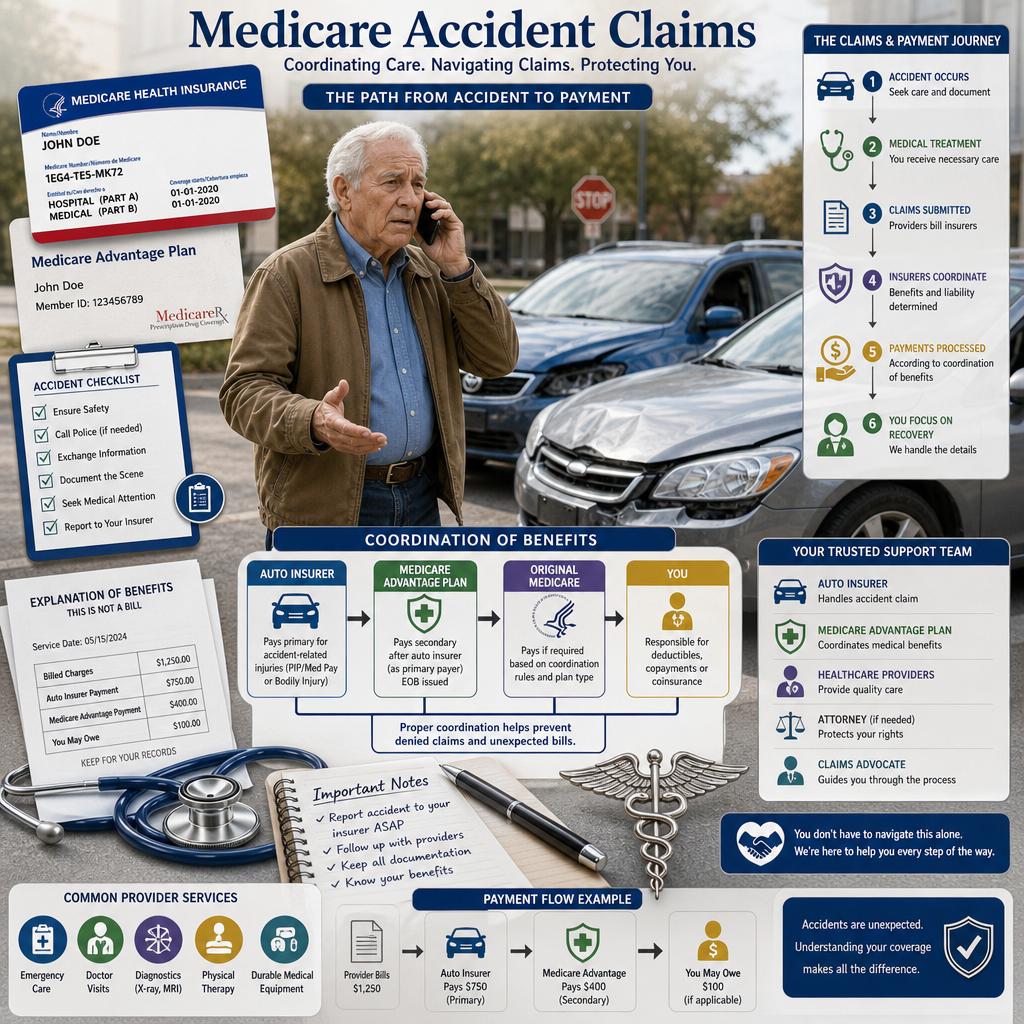
A Medicare card feels reassuring until another payer enters the room. Imagine a 72 year old retiree who is rear ended in February 2026, receives emergency care, starts physical therapy, fills pain medication, and later hears from an auto insurer, an attorney, a Medicare Advantage plan, and Medicare itself. Everyone is talking about payment, but not everyone is talking about coverage in the same language.
This is one of the least understood Medicare planning issues because it does not look like a plan decision at first. It looks like an accident. Yet the moment liability insurance, no fault coverage, workers compensation, employer coverage, or a settlement is involved, Medicare becomes part of a coordination system. Medicare reminds beneficiaries that the insurance paying first is the primary payer, the insurance paying second may not cover every remaining charge, and beneficiaries should update Medicare when other coverage changes .
Why an Accident Can Change the Order of Payment
Medicare is not always the first payer simply because you are enrolled. When another insurer is legally responsible for medical bills, that insurer may need to pay before Medicare. If Medicare pays before that responsibility is resolved, the payment may later have to be reconciled. That is why an accident claim can feel quiet for months and then suddenly generate letters asking for information, itemized bills, or repayment details.
The difficult part is that the beneficiary often experiences care in real time while the payment responsibility is still unsettled. The emergency department wants insurance information. The imaging center asks for a card. The physical therapy office needs authorization or a claim path. If the provider bills the wrong payer first, the claim can deny, pend, or reprocess later. This is not just paperwork. It can interrupt therapy, delay a refill, or create a balance that looks like patient responsibility when it may actually be a coordination issue.
Original Medicare and Medicare Advantage Do Not Handle the Experience the Same Way
Original Medicare gives broad access to Medicare enrolled providers, and in most cases beneficiaries do not need prior authorization for covered services or supplies. Medicare Advantage plans, by contrast, must cover medically necessary services that Original Medicare covers, but may require network use, referrals, or prior authorization for certain services and supplies . That distinction becomes very practical after an accident.
A beneficiary with Original Medicare and a Medigap policy may focus on whether the treating providers accept Medicare assignment and whether the accident insurer should pay first. A beneficiary in a Medicare Advantage HMO or PPO may have an additional layer: whether the orthopedist, imaging facility, rehabilitation provider, and pharmacy pathway are inside the plan’s rules. Medicare Advantage plans also have yearly limits on covered Medicare services, while Original Medicare has no yearly out of pocket limit unless the beneficiary has supplemental coverage such as Medigap, Medicaid, employer, retiree, or union coverage . That difference can matter when an injury produces months of appointments.
The Settlement Mistake Families Often Make
The most expensive mistake is assuming that once a settlement check arrives, the medical billing story is over. In reality, a settlement may close one chapter while opening another. Medicare, a Medicare Advantage plan, a drug plan, or another insurer may still need to reconcile accident related payments. If the beneficiary has been ignoring letters because the attorney is handling the injury claim, important insurance deadlines may be missed.
The official Medicare handbook gives beneficiaries a direct clue about the seriousness of coordination: if group health plan coverage ends or other insurance changes, Medicare says to call 1-800-MEDICARE or contact the Benefits Coordination and Recovery Center, known as the BCRC, at 1-855-798-2627 . That contact point matters because Medicare’s records must reflect who should pay and when. A stale coordination record can cause clean claims to be treated like disputed claims.
The 2026 Drug Cost Detail That Can Mislead Injured Retirees
In 2026, Part D has a major protection: covered Part D out of pocket drug costs are capped at $2,100 for the calendar year . That is meaningful for people using ongoing prescriptions, and it may help someone who needs covered pain medicine, anti inflammatory drugs, or other medications after an injury. But it should not be confused with a total accident cost cap.
The $2,100 figure is a Part D covered drug limit, not a shield against every medical bill tied to an accident. Emergency care, specialist visits, outpatient surgery, durable medical equipment, imaging, and therapy may fall under medical coverage rather than the Part D drug benefit. Original Medicare beneficiaries generally pay cost sharing for covered Part B services after any applicable deductible, often 20 percent of the Medicare approved amount when the provider accepts assignment, and Original Medicare itself has no yearly out of pocket ceiling without supplemental coverage . Medicare Advantage members may have a medical out of pocket maximum, but network and authorization rules can shape whether care is covered at the expected level.
What to Check Before You Assume a Bill Is Yours
A bill after an accident should be treated as evidence, not automatically as a final verdict. The first question is not only whether Medicare covers the service. The better question is whether the correct payer, correct plan, correct provider status, and correct accident related diagnosis information were used.
Before paying a large accident related bill in 2026, a beneficiary should slow down and verify the following:
- Whether the provider billed the correct payer first, whether Medicare or the Medicare Advantage plan has current other insurance information, whether the service was in network if a Medicare Advantage plan was involved, whether any required authorization was obtained, whether the charge belongs to Part A, Part B, Part D, or another insurer, and whether the bill matches the Medicare Summary Notice, Explanation of Benefits, or plan correspondence.
This is also where assignment matters. Under Original Medicare, assignment means the provider or supplier agrees to accept the Medicare approved amount as payment in full and not bill beyond the Medicare deductible and coinsurance . If a beneficiary is dealing with equipment after an injury, such as a walker, hospital bed, or wheelchair, the supplier question can be just as important as the doctor question. Medicare’s 2026 handbook warns that durable medical equipment suppliers who do not participate in Medicare or do not accept assignment may charge additional amounts, and rental arrangements should be checked for every rental month .
Why Plan Choice Before the Accident Still Matters After the Accident
No one chooses a Medicare plan expecting a crash, fall, or workplace injury. But the plan chosen during enrollment determines the rules that apply when life becomes complicated. A low premium Medicare Advantage plan may be excellent for routine care but restrictive if the post accident orthopedic group or rehabilitation center is outside the network. Original Medicare plus a Medigap policy may offer broader provider access, but premiums and drug coverage must be planned separately.
This is why accident coordination belongs in a serious 2026 Medicare review. The question is not simply, “What is my monthly premium?” It is, “If something unexpected happens, who helps me understand the payment order, network rules, drug costs, supplier status, and appeal path?” Medicare is a health coverage system, but in real life it is also a timing system. The wrong card at the wrong desk can create months of avoidable friction.
Professional Guidance Turns a Claim File Into a Coverage Plan
Vista Mutual helps clients look beyond brochure promises and into the actual mechanics of Medicare Advantage, Medicare Supplement, and Part D coverage. That means reviewing provider access, drug exposure, out of pocket risk, coordination concerns, and the practical consequences of choosing one Medicare structure over another.
If you are entering 2026 with an open accident claim, a recent settlement, multiple insurance cards, or uncertainty about whether your current plan is still the right fit, do not wait for the next confusing bill to make the issue urgent. Peace of mind comes from knowing how your coverage is supposed to work before the system tests you. Schedule your 2026 Medicare consultation with Vista Mutual and let experienced guidance turn Medicare complexity into a plan you can trust.