The 2026 Medicare Advantage Drug Coverage Lockout
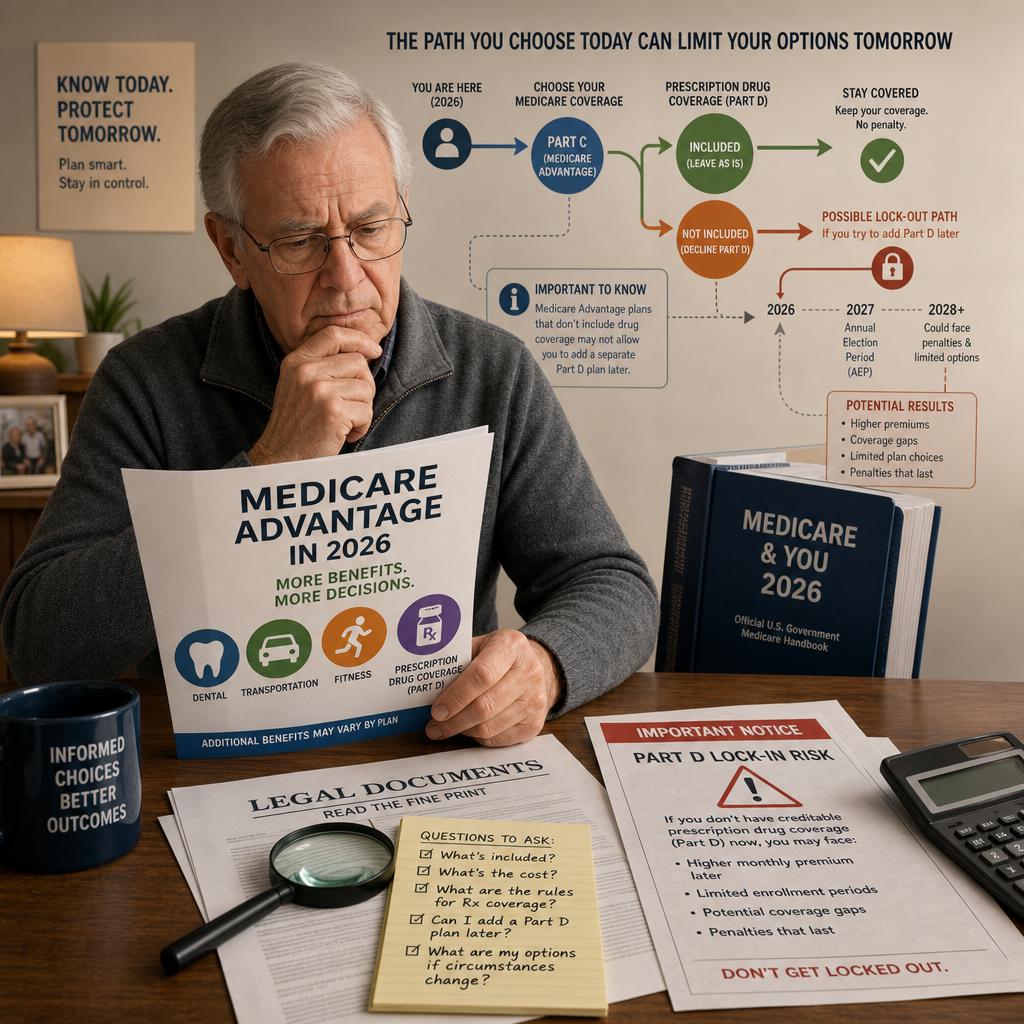
A low premium Medicare Advantage plan can feel like a clean decision in 2026. The brochure may emphasize dental allowances, transportation, fitness benefits, or a Part B premium reduction, while the drug coverage line appears almost secondary. For a healthy retiree taking only two inexpensive prescriptions, that can seem harmless.
The problem is that Medicare does not treat every Medicare Advantage plan without drug coverage the same way. One beneficiary may be allowed to add a separate Part D plan, while another may be blocked from doing so because of the type of Medicare Advantage plan selected. That distinction is rarely obvious at first glance, yet it can determine whether a retiree has access to covered medications, the 2026 Part D out of pocket cap, and protection against future late enrollment penalties.
The Plan Type Determines Whether You Can Add Part D
Medicare Advantage is not one uniform product. It is a private plan alternative to Original Medicare that bundles Part A and Part B, and most Medicare Advantage plans also include Part D prescription drug coverage. Medicare notes that these plans may require network use and approval for certain drugs or services, while often offering extra benefits that Original Medicare does not include . That combination is why many retirees focus on the visible extras and miss the structural question underneath: does this specific plan include drug coverage, and if not, am I legally allowed to add it somewhere else?
The answer depends on plan design. Medicare explains that in certain Medicare Advantage plan types that do not include drug coverage, such as Medical Savings Account plans and some Private Fee for Service plans, a beneficiary can join a separate Medicare drug plan. But if someone joins a Health Maintenance Organization plan or Preferred Provider Organization plan that does not cover drugs, Medicare says that person cannot join a separate Medicare drug plan . This is the 2026 drug coverage lockout: the beneficiary may have medical coverage through the HMO or PPO, but no ordinary path to bolt on a stand alone Part D plan.
Why The Mistake Is More Expensive In 2026
The lockout matters more in 2026 because Part D protection is more valuable than it used to be. Medicare states that yearly out of pocket drug costs for drugs covered by a Part D plan are capped at $2,100 in 2026, after which the beneficiary pays no copayment or coinsurance for covered Part D drugs for the rest of the calendar year . That cap can be a major safeguard for people who use brand name medications, specialty drugs, cancer drugs, inhalers, anticoagulants, or medications that change during the year.
But the cap only helps when the medication is covered under Medicare drug coverage. A retiree who enrolls in a drugless HMO or PPO without other creditable prescription coverage may not merely be missing a pharmacy benefit. They may be standing outside the 2026 Part D cost structure entirely. Medicare also warns that if a person goes without Medicare drug coverage when first eligible and does not have other creditable prescription drug coverage, a late enrollment penalty may be added to the monthly premium if they join Part D later . In practical terms, one enrollment decision can create both immediate pharmacy exposure and a long tail penalty risk.
The Retiree Who Thinks They Do Not Need Drug Coverage
Consider a 67 year old retiree who takes a generic blood pressure medication and an occasional antibiotic. During Annual Enrollment, she sees a Medicare Advantage PPO with a low premium and appealing dental benefits. The plan does not include Part D, but she assumes she can add a drug plan if her prescriptions become more complicated. That assumption may be wrong. If the PPO is a Medicare Advantage plan without drug coverage, Medicare rules may prevent her from enrolling in a separate stand alone Part D plan while she remains in that PPO.
The danger is not limited to people already taking expensive medications. Medicare drug costs depend on whether prescriptions are on the plan formulary, the tier assigned to each drug, the benefit phase, and the pharmacy used, including whether the pharmacy offers preferred or standard cost sharing . A person with modest needs in January may receive a new diagnosis in April, start an inhaler in June, or be prescribed an anticoagulant after a fall in September. By then, the attractive drugless plan may feel much less attractive.
Employer And Retiree Coverage Can Complicate The Analysis
There are situations where a Medicare Advantage plan without drug coverage may be intentional. Some retirees have employer, union, VA, TRICARE, Indian Health Service, or other prescription coverage that is designed to coordinate with Medicare. In those cases, the question is not simply whether the Medicare Advantage plan includes Part D. The more precise question is whether the outside drug coverage is creditable, whether enrolling in the Medicare Advantage plan affects eligibility for retiree benefits, and whether the pharmacy network works in real life.
Medicare specifically cautions beneficiaries to talk to an employer, union, or benefits administrator before joining a Medicare Advantage plan because, in some cases, joining a plan could cause loss of employer or union coverage for the retiree, spouse, or dependents, and that coverage may not be recoverable . This is where a plan that looks simple online becomes a legal and financial coordination issue. A broker who understands Medicare Advantage, Supplements, and Part D will not evaluate the plan in isolation. The correct review follows the coverage chain from doctor access to pharmacy access to retiree benefits to future enrollment rights.
The Documents That Reveal The Risk Before January
The warning signs are usually present before the plan year begins, but they may be buried in plan materials. Medicare says the Evidence of Coverage explains what the plan covers and what the beneficiary pays, while the Annual Notice of Change identifies changes in costs, coverage, provider networks, service area, and more for January . For 2026 decisions, these documents are not paperwork clutter. They are the legal map of what happens at the pharmacy counter.
The annual review window matters. Medicare states that October 1, 2025 is when beneficiaries can start comparing current Medicare health or drug coverage with 2026 options, and October 15 through December 7, 2025 is the Open Enrollment Period to join, switch, or drop Medicare Advantage or drug coverage for 2026 . Waiting until the first denied prescription in January is the expensive way to learn the rule. The better approach is to verify the plan type, confirm whether Part D is included, identify any outside creditable coverage, and test every current medication against 2026 formularies and pharmacy networks before enrollment.
The lesson is not that every Medicare Advantage plan without drug coverage is wrong. The lesson is that it is never a casual choice. In 2026, the difference between a plan that includes Part D, a plan that allows separate Part D enrollment, and a plan that blocks separate Part D enrollment can change the entire risk profile of retirement health care.
Vista Mutual Insurance Services helps clients look beyond the premium and the headline extras to the rules that actually govern access, cost, and future flexibility. If you want confidence that your 2026 Medicare Advantage, Medicare Supplement, and Part D strategy fits the way you receive care and fill prescriptions, Schedule your 2026 Medicare consultation.