The 2026 Medicare Advantage Extra Benefit Receipt Test
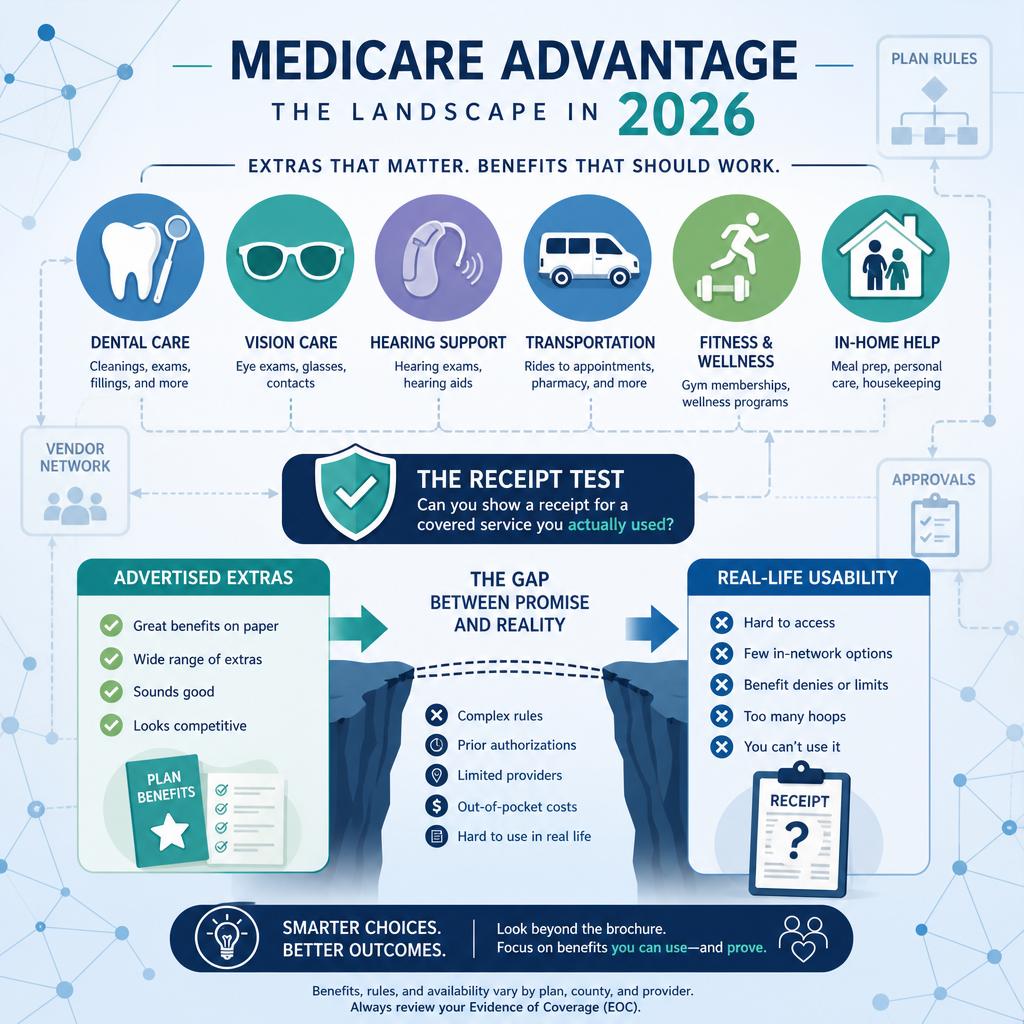
A Medicare Advantage plan can look exceptionally attractive in 2026 when the first page highlights dental allowances, vision credits, transportation, hearing support, fitness memberships, over the counter items, or in home help. For many retirees, those extras feel more tangible than the technical language of deductibles, referrals, formularies, and provider contracts. The problem is that a benefit printed in a brochure is not the same as a benefit successfully received.
At Vista Mutual, we often see the same pattern. A beneficiary chooses a plan because of an advertised extra, only to learn months later that the benefit requires a specific vendor, a prior approval step, a narrow service category, a quarterly spending limit, a network provider, or documentation that was never explained clearly at enrollment. In 2026, the smarter question is not, Does this plan include extra benefits? The better question is, What proof do I have that I can use this benefit in my real life?
Why Extra Benefits Are Not The Same As Core Medicare Coverage
Medicare Advantage is an alternative way to receive Medicare through a private plan approved by Medicare. These plans must cover medically necessary services covered by Original Medicare, but they may also offer extra benefits that Original Medicare does not cover, such as vision, hearing, dental, and other supplemental supports . That distinction matters because the rules for core medical care and the rules for supplemental benefits are not always experienced the same way by the member.
Original Medicare has its own structure, including broad access to Medicare enrolled providers who accept Medicare patients, but it generally does not include a yearly out of pocket limit unless the beneficiary has other coverage such as Medigap, Medicaid, employer, retiree, or union coverage . Medicare Advantage plans, by contrast, generally use plan rules, networks, cost sharing schedules, and a yearly limit on out of pocket costs for covered Part A and Part B services . That limit is important, but it does not automatically mean every advertised supplemental benefit is unlimited, unrestricted, or easy to redeem.
The 2026 Receipt Test Before You Trust A Benefit
Imagine a retired couple reviewing 2026 plans in October. One plan advertises generous dental. Another promotes transportation and a grocery related allowance. A third has a lower premium and hearing benefits. On paper, each one seems better than staying with a plan that has fewer extras. But the couple has a preferred dentist, a cardiologist across town, three brand name prescriptions, and a spouse who may need cataract follow up during the year. The plan with the most attractive extras may not be the plan that protects their actual medical life.
This is where the receipt test becomes useful. Before treating an extra benefit as meaningful, you should be able to answer one practical question: If I needed this benefit next month, exactly how would I obtain it, from whom, at what cost, with what approval, and under what limit? If the answer is vague, the benefit may still be valuable, but it should not drive the entire plan decision.
The most reliable source is not the postcard or television advertisement. Medicare explains that the Evidence of Coverage gives details about what a plan covers and what you pay, while the Annual Notice of Change explains changes in coverage, costs, provider networks, service area, and more that take effect in January . For a serious 2026 plan review, those documents are not administrative clutter. They are the contract language that separates a usable benefit from a pleasant headline.
The Hidden Friction Points That Change The Value
The biggest mistake is evaluating extra benefits as if they were cash. A dental allowance may not behave like money in your wallet. A transportation benefit may require advance scheduling, mileage limits, approved trip purposes, or a contracted transportation vendor. A hearing benefit may apply only through a particular provider network or device arrangement. A vision allowance may be generous for frames but less helpful if your ophthalmology care is driven by a medical condition billed under Part B rules.
Medicare Advantage costs can depend on several variables at once, including the monthly premium, any yearly deductible, visit or service copayments, whether a provider is in network, whether extra benefits require additional payment, and the plan’s yearly out of pocket limit for Part A and Part B covered services . That is why two beneficiaries in the same ZIP code can choose the same plan and have very different outcomes. One uses the dental network easily and saves money. The other discovers that a long time dentist does not participate and that switching dentists would disrupt complex care.
There is another quiet issue in 2026: prior approval. Medicare notes that Medicare Advantage members may need approval from their plan before certain services or supplies are covered . The same psychology applies to supplemental benefits. If a plan requires a formal step before the benefit is available, failing to follow that step can turn an advertised advantage into an unexpected bill or an unused benefit.
Why Drug Savings Do Not Solve Every Plan Design Problem
The 2026 Part D out of pocket cap is an important protection. Medicare states that yearly out of pocket costs for covered Part D drugs are capped at $2,100 in 2026, after which the beneficiary pays no copayment or coinsurance for covered Part D drugs for the rest of the calendar year . That can be a major relief for people with expensive covered prescriptions.
But the Part D cap should not be confused with a universal health care spending cap. It applies to covered Part D drugs, not to dental services, hearing aids, routine vision items, transportation benefits, fitness programs, or noncovered services. A beneficiary who chooses a plan because the prescription side looks safer still needs to test the medical network, specialist access, prior authorization rules, and supplemental benefit restrictions. A drug cap can improve one part of the risk picture while leaving other parts of the plan decision just as complex.
A Smarter Way To Compare 2026 Medicare Advantage Extras
One carefully used checklist can prevent a costly misunderstanding:
- Confirm the exact benefit in the Evidence of Coverage, not just the marketing summary.
- Ask whether the benefit uses a network, preferred vendor, reimbursement process, card, catalog, portal, or prior approval.
- Verify whether the benefit renews monthly, quarterly, annually, or only after a triggering medical event.
- Check whether unused amounts roll over or disappear.
- Compare the benefit against your actual doctors, prescriptions, dental providers, travel habits, and expected procedures.
The discipline is to make the plan prove itself before you enroll. If a benefit depends on a vendor, call the vendor. If it depends on a provider network, verify participation directly with the provider and the plan. If it depends on a card or allowance, ask what categories qualify and what merchants or services are excluded. A polished summary can tell you what exists. Only verification tells you whether it works for you.
The Plan That Looks Rich May Not Be The Plan That Fits
A high end Medicare review is not about chasing the longest list of extras. It is about matching plan design to medical reality. The right plan for a healthy retiree who values gym access and preventive dental cleanings may be the wrong plan for someone with oncology follow ups, orthopedic needs, multiple specialists, and a dentist managing implants or periodontal disease. Medicare Advantage plans can be valuable, but they are engineered systems, not simple discount cards.
Professional guidance matters because the plan decision often turns on the interaction of several details at once. Network access, drug tiers, Part D cost exposure, prior authorization, extra benefits, premiums, out of pocket limits, and Medigap tradeoffs all have to be weighed together. The most expensive mistake is not choosing a plan with fewer extras. It is choosing a plan whose extras distracted you from the care you were most likely to need.
In 2026, Medicare beneficiaries have more information than ever, but more information does not always create clarity. The peace of mind comes from having someone translate the documents, test the assumptions, and identify the risks before enrollment becomes a claim problem. If you want a careful, personalized review of your Medicare Advantage, Supplement, or Part D options, Schedule your 2026 Medicare consultation with Vista Mutual.