The 2026 Medicare Audiology Direct Access Rule Seniors Can Easily Misread
A retired teacher notices that conversation at Sunday dinner has become harder to follow. Her daughter says, kindly but firmly, that it is time to get her hearing checked. In 2026, she may have heard that Medicare now allows some direct access to an audiologist, and that sounds simple enough. Call the audiology office, get an appointment, and let Medicare handle the rest.
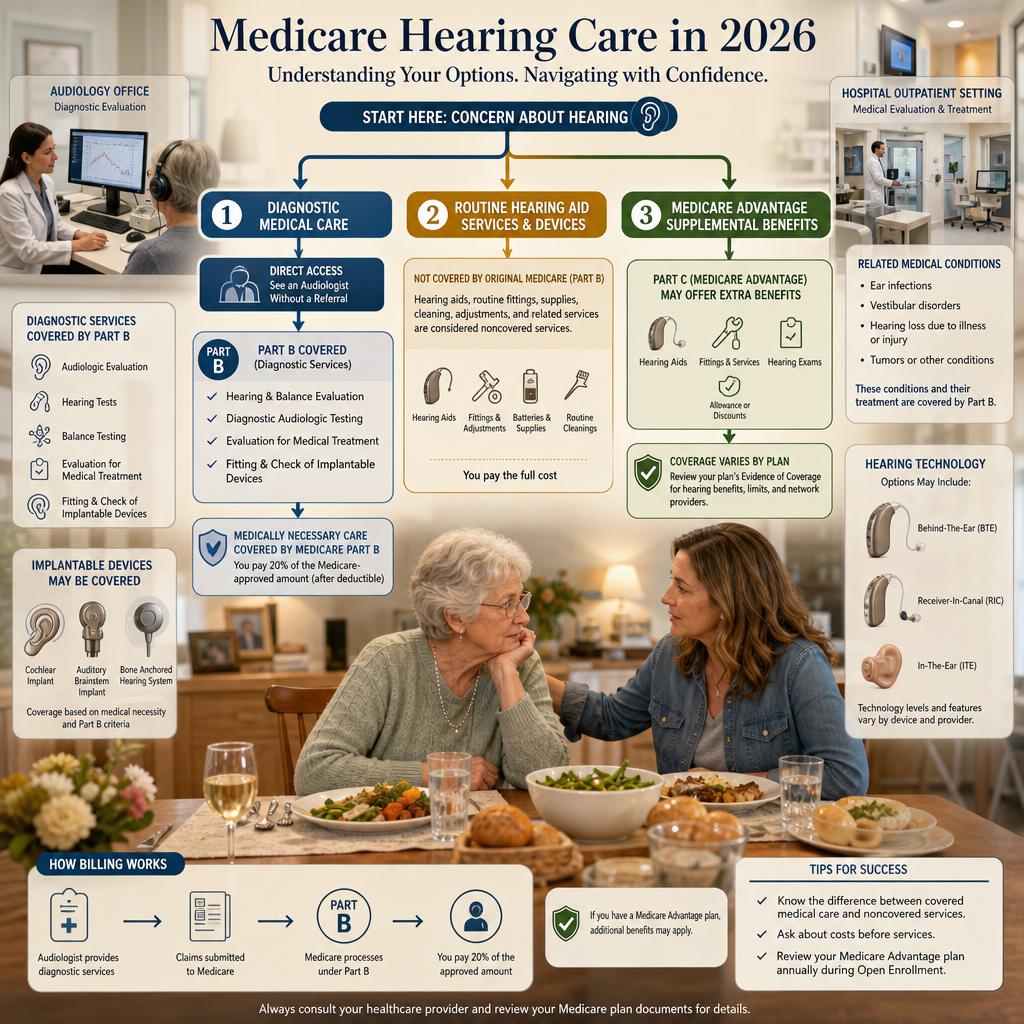
That is where the misunderstanding begins. Medicare’s hearing rules are not one rule. They are a narrow set of medical coverage pathways sitting beside a much larger category of noncovered routine hearing aid services. The difference can determine whether a visit is processed as a Part B diagnostic service, a Medicare Advantage supplemental benefit, or a private-pay appointment the beneficiary never expected.
Direct Audiology Access Is Real But Narrow
The 2026 Medicare handbook confirms that Medicare covers diagnostic hearing and balance exams when a doctor or other health care provider orders them to determine whether medical treatment is needed. It also states that a beneficiary can visit an audiologist once every 12 months without an order, but only for non-acute hearing conditions, such as gradual hearing loss over many years, and for diagnostic services related to hearing loss treated with surgically implanted hearing devices .
That language matters. It does not create an unlimited hearing benefit. It creates a limited direct-access diagnostic route. A person with long-developing hearing loss may be able to begin with an audiologist without first asking a primary care doctor for an order, but Medicare is still looking at the visit through a medical diagnostic lens. If the appointment turns into hearing aid selection, fitting, retail device counseling, or routine aid adjustment, the coverage analysis changes.
The Visit May Be Covered While The Hearing Aid Is Not
Original Medicare still does not usually cover hearing aids or exams for fitting hearing aids, and the handbook states that directly after explaining diagnostic hearing and balance exam coverage . This is the sentence beneficiaries often miss because it appears beside a rule that sounds more generous than it really is. Medicare may help pay for the diagnostic evaluation, but the device conversation can still fall outside Original Medicare.
For the covered diagnostic portion, the usual Part B cost structure applies. The beneficiary pays 20 percent of the Medicare-approved amount, the Part B deductible applies, and there may also be a copayment when the service is furnished in a hospital outpatient setting . In practical terms, two people can walk into similar appointments and leave with very different bills because one visit was coded as a covered diagnostic service and the other included noncovered hearing aid services.
Medicare Advantage Adds Benefits But Also Adds Rules
Many Medicare Advantage plans advertise hearing benefits, and some are genuinely valuable. The mistake is assuming that every plan uses the same allowance, provider network, device catalog, fitting rules, and frequency limits. Medicare Advantage plans must cover medically necessary services covered by Original Medicare, but they may also offer extra benefits that Original Medicare does not, including benefits such as hearing, dental, and vision services .
That creates a second layer of complexity. Under Original Medicare, the question is often whether the audiology service is diagnostic and covered under Part B. Under Medicare Advantage, the beneficiary must also ask whether the audiologist is in network, whether prior authorization or plan approval is required, whether the benefit is an allowance or a defined device package, and whether the plan’s hearing vendor is separate from the medical network. Medicare’s own comparison of coverage options notes that Medicare Advantage members may need to use network providers and may need approval before certain services or supplies are covered .
The Hospital Outpatient Setting Can Change The Bill
A subtle 2026 planning issue is location. A beneficiary may think, reasonably, that an audiology test is an audiology test. Medicare billing does not always see it that way. When a diagnostic hearing or balance exam is performed in a hospital outpatient department, the handbook warns that a copayment may apply in addition to the Part B deductible and 20 percent coinsurance .
That is why a freestanding audiology office, an ENT-owned clinic, and a hospital outpatient department can produce different patient experiences. The clinical purpose may be similar, but the billing setting may not be. This is not about avoiding medically appropriate care. It is about knowing before the appointment whether the site of service could create a facility-related cost that the patient did not anticipate.
The Surgically Implanted Device Exception Needs Careful Handling
The direct-access language also refers to diagnostic services related to hearing loss treated with surgically implanted hearing devices . That can be important for beneficiaries with cochlear implants or other implanted hearing technology because their follow-up care may not fit the ordinary hearing aid framework. But even here, precision matters. The fact that a person has an implanted device does not mean every accessory, upgrade, battery arrangement, mapping visit, or related service is automatically handled the same way.
This is where an experienced Medicare review can prevent frustration. The documentation should connect the service to the covered medical need, the provider should be properly enrolled or contracted, and the beneficiary should understand whether the claim is being billed under Original Medicare Part B, a Medicare Advantage medical benefit, or a plan’s supplemental hearing vendor benefit. A beneficiary should not wait until the explanation of benefits arrives to learn which pathway was used.
A Better 2026 Question Than Does Medicare Cover Hearing
The consumer question is usually, “Does Medicare cover hearing?” The better 2026 question is, “Which part of my hearing care is diagnostic medical care, which part is routine hearing aid care, and which part depends on my plan’s extra benefits?” That one sentence separates a careful Medicare strategy from a marketing assumption.
Before scheduling, a beneficiary should ask the audiology office whether the visit will be billed as a Medicare-covered diagnostic hearing or balance exam, whether an order is required for the reason they are being seen, whether the provider accepts Medicare assignment or participates in the Medicare Advantage network, and whether any portion of the appointment is considered a noncovered hearing aid fitting or retail service. This is the kind of conversation that feels overly technical until it prevents a bill.
The 2026 Medicare landscape rewards precision. A small phrase such as “once every 12 months without an order” can sound like broad access, while the actual coverage remains highly conditional. Vista Mutual helps clients separate the medical benefit from the supplemental benefit, compare Original Medicare and Medicare Advantage tradeoffs, and anticipate costs before care begins. For confidence before you book the appointment or choose a plan, Consult with the Vista Mutual team.