The 2026 Medicare Part B Drug Coinsurance Repricing Rule
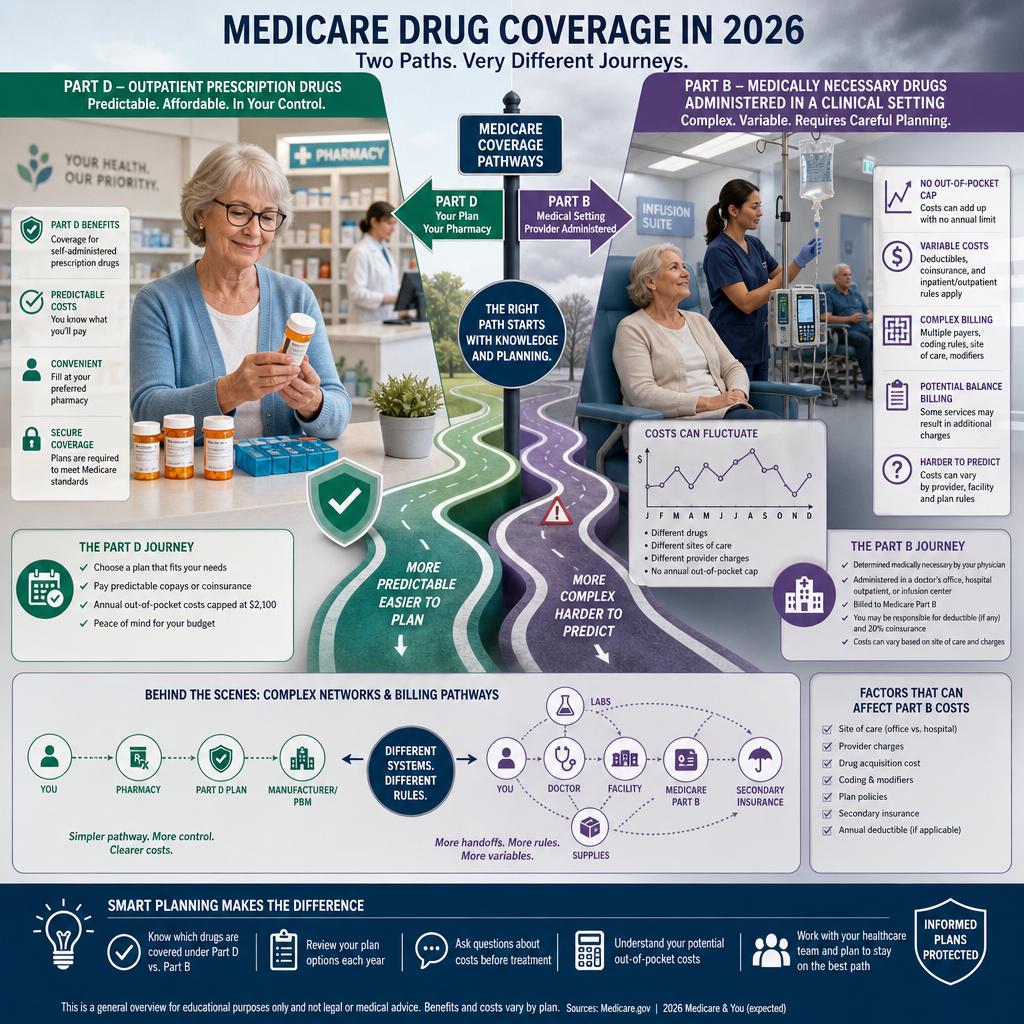
A retired teacher with rheumatoid arthritis may enter 2026 believing her drug costs are finally predictable because she has heard about the Part D out-of-pocket cap. Her neighbor, who takes several pharmacy prescriptions, may in fact benefit from that protection. But if her biologic is administered in a physician office, hospital outpatient department, or infusion suite, the billing path may run through Medicare Part B instead of Part D, and that distinction can change the entire financial conversation.
This is one of the most misunderstood drug issues in Medicare planning. Medicare drug coverage is not one system. It is a series of pathways: Part D for most outpatient prescriptions, Part B for many provider-administered drugs, Medicare Advantage rules for plan administration, and supplemental coverage that may or may not reduce what the patient feels at the counter or clinic. In 2026, the beneficiaries most likely to be surprised are often the ones receiving sophisticated care.
Why The 2026 Drug Cap Does Not Cover Every Medication
The 2026 Medicare handbook confirms an important improvement for people with Medicare drug coverage: yearly out-of-pocket costs for covered Part D drugs are capped at $2,100 in 2026, after which the beneficiary does not owe copayments or coinsurance for covered Part D drugs for the rest of the calendar year . That is a meaningful protection, but the phrase covered Part D drugs is doing a great deal of work.
Part B may cover certain infused and injected drugs given in a doctor’s office, some drugs used with medical equipment, and insulin used with a traditional pump, while most routine self-administered retail prescriptions generally fall under Part D if the beneficiary has drug coverage . The practical result is that two people can receive high-cost medications in the same year and face very different rules. One may be tracking toward the Part D cap, while the other is paying a percentage of a Medicare-approved Part B amount, possibly visit after visit.
The Quarterly Price Change Few Patients See Coming
For Part B drugs, Medicare explains that beneficiaries generally pay 20% of the Medicare-approved amount after the Part B deductible applies, assuming the doctor or other provider accepts assignment . That sounds simple until the actual drug price changes. In 2026, Medicare continues to note that coinsurance for certain Part B-covered drugs and biologicals may be lower when those products are received in a doctor’s office, pharmacy, or hospital outpatient setting if their prices have increased faster than inflation, and that the specific drugs and potential savings change every quarter .
That quarterly movement matters because a January estimate may not match an April bill. A patient receiving eye injections for retinal disease, chemotherapy support drugs, immune therapies, or rheumatology infusions may reasonably ask the clinic, “What will I owe?” The honest answer may require more than looking at last year’s explanation of benefits. It may require confirming the site of service, the billing code, whether the provider accepts assignment, whether the drug is under Part B or Part D, and whether a Medicare Advantage plan requires prior authorization.
Original Medicare And Medicare Advantage Handle The Risk Differently
Under Original Medicare, access is often broader. Medicare says beneficiaries can generally use any Medicare-enrolled doctor, provider, hospital, or facility that accepts Medicare patients anywhere in the United States . But Original Medicare also has a serious exposure point: there is no yearly limit on what a beneficiary pays out of pocket unless other coverage such as Medigap, Medicaid, employer, retiree, or union coverage helps absorb those costs .
Medicare Advantage plans must cover medically necessary services covered by Original Medicare, but the plan structure can add its own rules. Medicare notes that Advantage plans may require network providers, referrals, or prior authorization, and that plans have yearly limits on what members pay for Part A and Part B-covered services . For a patient on a recurring Part B drug, that out-of-pocket maximum can be valuable, but only if the treating physician, infusion site, drug authorization, and diagnosis pathway all line up with the plan’s rules.
The Site Of Service Can Change The Bill
The same medication conversation can feel different depending on where care is delivered. A physician office infusion, a hospital outpatient department, and a pharmacy-supplied injectable can involve different billing workflows. Medicare specifically warns that Part B-covered drugs received in a hospital outpatient setting may be part of outpatient services, and in that case the beneficiary may pay a copayment for the services . That is why patients sometimes see both a drug cost and a facility-related charge attached to the same episode of care.
The subtle danger is assuming the prescribing doctor controls the entire financial experience. Clinically, the doctor may choose the right medication. Administratively, the claim may still be shaped by the place of care, the plan contract, the plan’s preferred sites, or whether a lower-cost biosimilar is treated differently by the plan. Sophisticated Medicare planning asks not only, “Is the drug covered?” It asks, “Covered under which part, at which location, with which provider, and after which approval?”
The Four Questions To Ask Before A Part B Drug Starts
Before a high-cost injection or infusion begins in 2026, patients should pause long enough to get answers in writing when possible. The most useful questions are not confrontational. They are protective.
- Will this medication be billed under Medicare Part B or Medicare Part D?
- If it is Part B, what is the expected coinsurance and does the provider accept assignment?
- If I am in Medicare Advantage, is prior authorization required and is this site in network?
- Could the cost change during the year because of quarterly Part B drug pricing adjustments?
These questions are especially important for beneficiaries comparing a Medicare Advantage plan against Original Medicare with a Supplement. The lowest premium option is not always the least expensive option for someone who needs recurring Part B medications. Conversely, an Advantage plan with strong specialist access and a manageable out-of-pocket maximum may be appropriate for some patients, provided the drug and provider pathway are verified before enrollment.
Why Professional Review Matters More In 2026
The Part D cap is one of the most visible Medicare changes in 2026, but visibility can create false confidence. Medicare itself separates the Part D cap from Part B drug rules, and beneficiaries who receive provider-administered medications may never touch the protection they thought would solve their largest drug expense. That is not a loophole in the casual sense. It is a structural feature of Medicare.
A careful plan review should examine the full medical pattern: diagnoses, specialists, infusion centers, hospital outpatient exposure, pharmacy prescriptions, Medigap eligibility, Advantage prior authorization rules, and the beneficiary’s tolerance for network management. It should also recognize that the right answer for a healthy spouse may be wrong for the spouse receiving injections every six weeks.
In 2026, the safest Medicare decision is not simply choosing the plan with the familiar logo or the lowest advertised premium. It is choosing coverage after mapping how your actual care is likely to be billed. For beneficiaries using Part B drugs, that mapping can be the difference between a predictable year and a costly surprise.
Vista Mutual helps clients translate these technical rules into practical plan decisions. If you or a family member receives infusions, injections, biologics, oncology drugs, or retina treatments, do not wait until the first claim arrives to learn which part of Medicare applies. Schedule your 2026 Medicare consultation and gain the peace of mind that comes from having your coverage reviewed before the bills begin.