The 2026 Medicare Primary Care Setting Test That Can Decide Whether Counseling Is Free
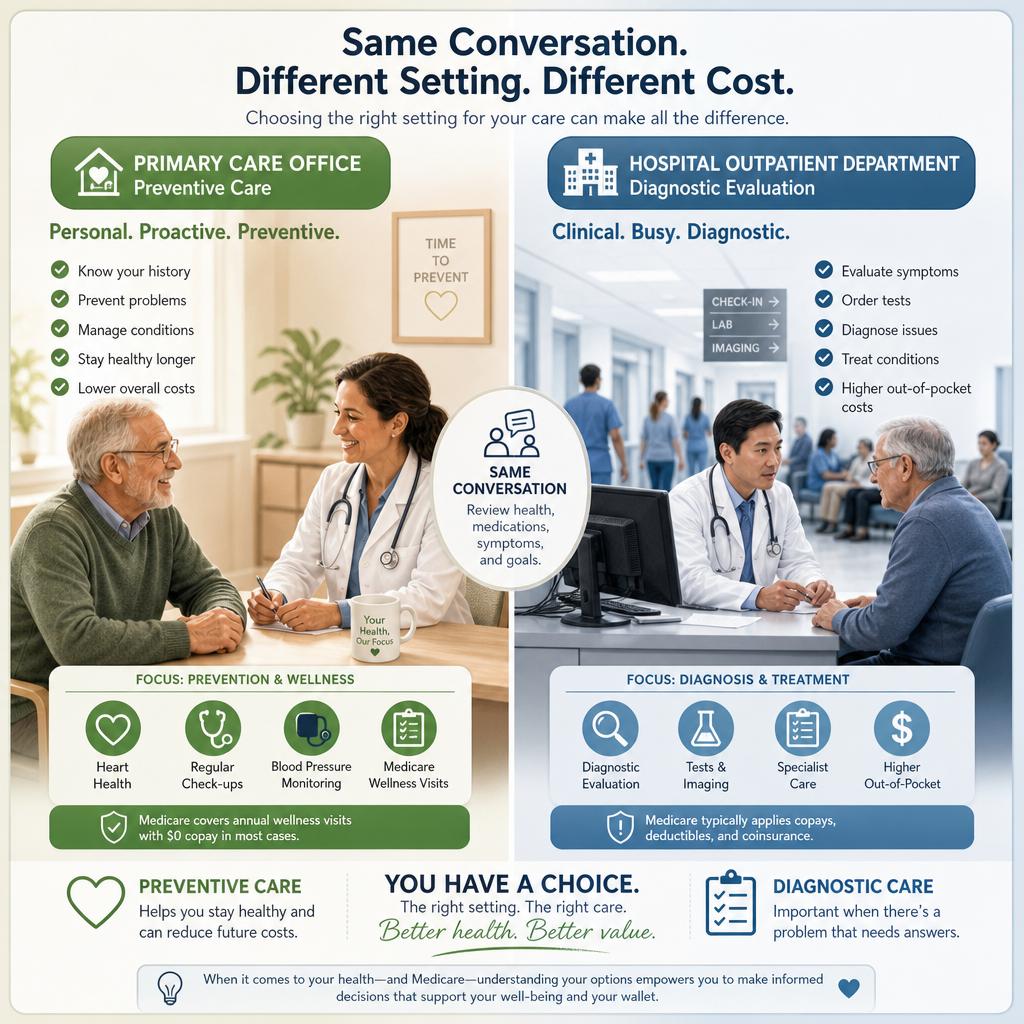
Medicare beneficiaries often learn the hard way that preventive does not always mean free in every room, with every clinician, or during every appointment. In 2026, one of the least appreciated coverage details is the primary care setting test, a quiet rule that can determine whether counseling for heart risk, sexual health, alcohol use, weight, or other prevention needs is treated as a no cost Medicare service or becomes part of a billable medical visit.
Imagine a 68 year old retiree named Ellen who schedules what she believes is a routine conversation about lowering her cardiovascular risk. Her neighbor had a similar discussion and paid nothing, so Ellen assumes the same will happen. But Ellen sees a specialist in a hospital outpatient department, while her neighbor saw a primary care physician in an office setting. That difference can matter because Medicare does not price every preventive conversation the same way in every clinical setting.
Why The Setting Can Matter More Than The Topic
Medicare covers many preventive services with no cost sharing when the service is performed correctly and the provider accepts assignment. The 2026 Medicare handbook is clear that most covered preventive services cost nothing when provided by a doctor or other health care provider who accepts assignment, but it also warns that deductibles or coinsurance may apply to some preventive services or when non preventive services are added during the same visit . That is the first layer of complexity: the benefit may be preventive, but the appointment can still contain billable components.
The second layer is where Vista Mutual often sees confusion. Some counseling benefits are tied not only to the patient’s risk profile, but also to the type of clinician and care setting. Medicare’s cardiovascular behavioral therapy benefit, for example, is covered once each year with a primary care doctor or other primary care provider in a primary care setting, and it is intended to reduce cardiovascular disease risk through discussion of aspirin use when appropriate, blood pressure checking, and nutrition guidance. When those conditions are met and the provider accepts assignment, the beneficiary pays nothing .
The No Cost Benefit Is Not A Blank Check
This is where the phrase “covered by Medicare” can mislead even careful beneficiaries. A covered preventive counseling benefit may be no cost only when Medicare’s exact conditions are satisfied. If the service happens as part of a broader diagnostic appointment, or if the clinician treats a new symptom, orders additional testing, adjusts medications, or evaluates an active complaint, that portion of the encounter may no longer fit neatly inside the preventive benefit.
The yearly Wellness visit illustrates the same principle. Medicare says the annual Wellness visit is not a physical exam, but a visit to develop or update a personalized prevention plan based on current health and risk factors . The same section warns that if the provider performs additional tests or services during that visit that are not covered under the preventive benefit, coinsurance may apply and the Part B deductible may apply; if Medicare does not cover the added service, such as a routine physical exam, the patient may have to pay the full amount .
A 2026 Example That Looks Ordinary Until The Claim Arrives
Consider Robert, age 72, who has high blood pressure and a family history of heart disease. During a January 2026 visit, he asks whether he should take aspirin, whether his diet is increasing his risk, and whether his home blood pressure readings are concerning. If this conversation is structured as Medicare’s annual cardiovascular behavioral therapy visit with an eligible primary care provider in a primary care setting, Robert may owe nothing if the provider accepts assignment.
Now change one detail. Robert mentions new chest tightness when climbing stairs. His doctor appropriately shifts from prevention to diagnosis, documents a symptom, orders an EKG, and discusses whether Robert needs cardiology evaluation. The visit may still include preventive counseling, but part of the encounter may now be diagnostic. Medicare covers routine EKG screenings only when referred during the one time Welcome to Medicare visit, and after the deductible, beneficiaries generally pay 20 percent of the Medicare approved amount for that screening; diagnostic EKGs are also covered under separate rules and may involve cost sharing, especially in hospital or hospital owned clinic settings . Robert did nothing wrong. His doctor did the clinically responsible thing. The issue is that the billing changed because the medical purpose changed.
Sexual Health Counseling Shows The Rule Even More Clearly
A similar pattern appears in Medicare’s sexually transmitted infection screening and counseling benefit. Medicare covers STI screenings for chlamydia, gonorrhea, syphilis, and hepatitis B for people who are pregnant or at increased risk when ordered by a primary care doctor or other health care provider. Medicare also covers up to two individual, face to face, high intensity behavioral counseling sessions each year for sexually active adults at increased risk, but only with a primary care doctor or provider in a primary care setting. The handbook specifically says Medicare will not cover that counseling as a preventive service in an inpatient setting, such as a skilled nursing facility .
That last sentence is not a minor technicality. It means a beneficiary can have the right risk profile, the right clinical need, and a counseling conversation that is medically appropriate, yet still miss the preventive no cost pathway if the setting does not match Medicare’s rule. For older adults who receive care across multiple sites, including hospital outpatient departments, rehabilitation settings, skilled nursing facilities, and specialty clinics, this is exactly the kind of distinction that rarely appears in plan advertisements.
Original Medicare And Medicare Advantage May Handle The Experience Differently
Under Original Medicare, the key questions often begin with whether the service is covered, whether the provider accepts assignment, whether the encounter remained preventive, and whether the setting requirements were met. Original Medicare generally allows beneficiaries to use any Medicare enrolled doctor or hospital that accepts Medicare patients anywhere in the United States, but beneficiaries can face cost sharing when a service falls outside the no cost preventive structure or becomes diagnostic .
Medicare Advantage adds another layer. Medicare Advantage plans must cover all medically necessary services that Original Medicare covers, and most plans include drug coverage and may offer extra benefits, but members may need network providers, referrals, and prior authorization for certain services or supplies . A counseling benefit that looks simple under Original Medicare can become more complicated if the plan requires a primary care provider selection, limits certain non emergency out of network care, or uses different copays for office based and hospital outpatient services.
The Questions To Ask Before A Preventive Counseling Visit
Before assuming a 2026 counseling visit will be free, beneficiaries should ask a few precise questions rather than relying on the word preventive alone:
- Is this visit being scheduled and billed as a Medicare preventive counseling service, and does it require a primary care provider in a primary care setting?
- Does the provider accept Medicare assignment, or, in Medicare Advantage, is the provider in network for this plan?
- Will any diagnostic evaluation, lab work, imaging, medication adjustment, or treatment discussion be added during the same appointment?
- If I bring up a new symptom, could part of the visit become subject to deductible, coinsurance, or a copay?
- Does my Medicare Advantage plan require referrals, prior authorization, or a specific primary care location for this service?
These questions are not about avoiding necessary care. They are about understanding how Medicare classifies care. A new symptom should never be ignored just to preserve a no cost visit. But a patient deserves to know when the appointment has shifted from prevention to diagnosis, because that shift can affect the claim.
Why Professional Guidance Matters In 2026
The larger lesson is that Medicare planning is not only about premiums, dental allowances, or whether a plan includes a favorite pharmacy. It is also about how real care is delivered. A plan that looks inexpensive on paper may be less attractive if most of a beneficiary’s care happens in hospital outpatient departments, if their preferred physicians are outside the network, or if routine counseling and chronic condition management are likely to become mixed visits with cost sharing.
This is where an experienced brokerage can add value beyond a brochure comparison. Vista Mutual reviews how a person actually uses care: primary doctors, specialists, prescriptions, chronic conditions, travel patterns, preferred hospitals, and tolerance for referrals or prior authorization. In 2026, the difference between a smooth Medicare experience and a frustrating one may come down to details as small as where a counseling conversation takes place.
Medicare rewards preparation. When beneficiaries understand the primary care setting test, they can schedule smarter, ask better billing questions, and choose coverage that fits their real medical life. For peace of mind before you commit to a Medicare Advantage, Supplement, or Part D strategy, Consult with the Vista Mutual team.