The 2026 Medicare Psychiatric Hospital Coverage Gap Families Rarely See Coming
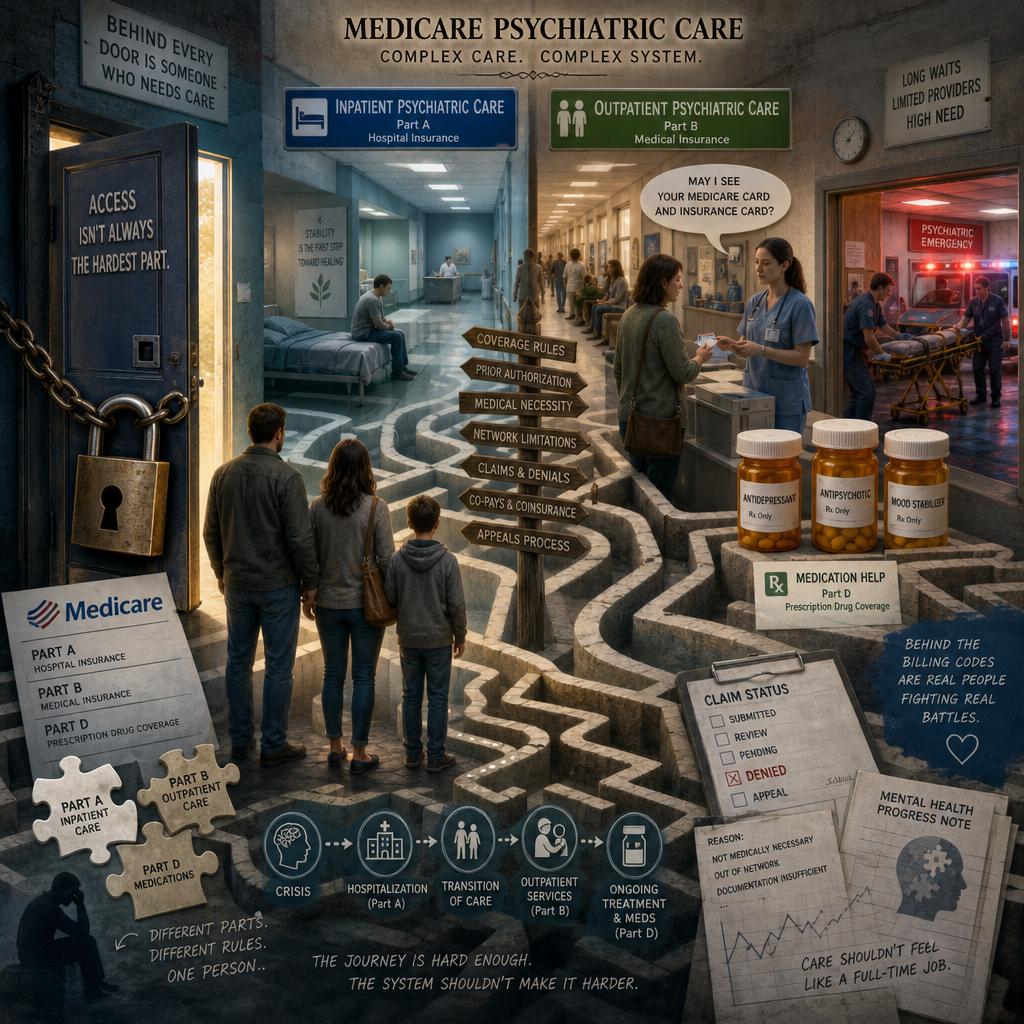
When a spouse, parent, or adult child is in psychiatric crisis, Medicare does not feel like a policy system. It feels like a locked door, a hospital hallway, a nurse asking for a card, and a family trying to remember whether the current plan is Original Medicare, a Medicare Advantage HMO, or a PPO with mental health providers scattered across three counties.
That is exactly why inpatient psychiatric care deserves its own 2026 Medicare conversation. The coverage exists, but it is not a single seamless benefit. Medicare may treat one hour of care as outpatient crisis intervention, another as observation, another as inpatient hospital care, and another as post discharge therapy or prescription drug management. The clinical story may feel continuous. The billing story is not.
Psychiatric Admission Is Covered But The Setting Controls The Claim
Medicare states that inpatient hospital care can include psychiatric care in inpatient psychiatric facilities, along with care in acute care hospitals, critical access hospitals, inpatient rehabilitation facilities, long term care hospitals, and inpatient care tied to qualifying clinical research studies . That language is reassuring, but it is not the end of the analysis. The family still needs to know whether the patient has been formally admitted as an inpatient, whether the stay is being handled under Part A hospital rules, and whether physician services during the stay are being billed separately under Part B.
This distinction matters because Medicare also explains that doctors services received while a person is in the hospital are generally covered at 80 percent of the Medicare approved amount if the patient has Part B . Families often hear the phrase “hospitalized” and assume every bill will be wrapped into one hospital benefit. In practice, the facility charge, psychiatrist visits, medical consults, lab work, and drugs after discharge may travel through different Medicare pathways.
Observation Can Look Like Admission Until The Bill Arrives
A psychiatric crisis commonly begins in an emergency department, especially when there is suicidal thinking, psychosis, severe medication destabilization, or unsafe behavior at home. The patient may spend the night in a secure area or medical bed while the hospital searches for placement. To the family, this looks and feels like admission. Under Medicare rules, that may not be true.
Medicare draws a sharp line between being formally admitted as an inpatient by a doctor’s order and being an outpatient receiving emergency or observation services, even if the person stays overnight in the hospital . If observation lasts more than 24 hours, the hospital must provide a Medicare Outpatient Observation Notice, often called a MOON, explaining why the person is outpatient and how that status affects costs and later care . In a psychiatric case, this notice can be easy to miss because the family is focused on safety, medication, transportation, and placement. Missing it can leave everyone confused about why Part A did not pay the way they expected.
Outpatient Mental Health Has Expanded But It Is Not The Same As Inpatient Care
Many 2026 Medicare planning mistakes happen after discharge. A patient may leave the hospital with a referral to therapy, psychiatry, partial hospitalization, an intensive outpatient program, medication management, or crisis follow up. These services may be clinically related, but Medicare does not treat them all the same way.
Medicare covers outpatient mental health care for conditions such as depression and anxiety, including counseling or psychotherapy in individual, group, family, and crisis settings. The 2026 handbook identifies outpatient settings such as a provider’s office, hospital outpatient department, or telehealth, and lists covered clinicians that may include psychiatrists, clinical psychologists, marriage and family therapists, mental health counselors, clinical social workers, nurse practitioners, physician assistants, and other qualified providers . Generally, outpatient mental health services are subject to 20 percent of the Medicare approved amount, and the Part B deductible applies .
That post discharge plan may also involve partial hospitalization or intensive outpatient program services. Medicare describes partial hospitalization as a structured day program, typically four to eight hours per day, for patients who need intensive psychiatric care but not full hospitalization. Intensive outpatient services may be provided through hospitals, Community Mental Health Centers, Federally Qualified Health Centers, Rural Health Clinics, and certain Opioid Treatment Programs when tied to opioid use disorder care . For families, the insider question is not simply “Is therapy covered?” It is “Which level of care has been ordered, which provider type is delivering it, and which part of Medicare or which plan rule applies?”
Medicare Advantage Adds A Network And Authorization Layer
The same psychiatric episode can look very different under Original Medicare than under a Medicare Advantage plan. Original Medicare generally lets beneficiaries use any Medicare enrolled doctor, provider, hospital, or facility that accepts Medicare patients anywhere in the United States . Medicare Advantage plans, by contrast, may require the patient to use network providers and service areas for non emergency care, and some plans require referrals or prior authorization before certain services are covered .
That does not make Medicare Advantage good or bad. It makes it operationally different. A Medicare Advantage plan may have a yearly out of pocket limit for covered Medicare services, while Original Medicare has no yearly out of pocket limit unless the beneficiary has supplemental coverage such as Medigap, Medicaid, employer, retiree, or union coverage . But that protection has to be weighed against network access. In behavioral health, a low premium plan can become frustrating if the nearest in network psychiatrist is overbooked, the preferred inpatient psychiatric facility is not contracted, or the discharge program requires plan approval.
The Medication Piece Can Change The 2026 Financial Picture
Psychiatric hospitalization often leads to prescription changes. A beneficiary may leave with an antipsychotic, mood stabilizer, antidepressant, sleep medication, medication for anxiety, or treatment for co occurring substance use disorder. These drugs may fall under Part D if filled at a pharmacy after discharge, and the drug plan’s formulary, tier placement, pharmacy contracts, and utilization rules can all affect what happens next.
For 2026, the major protection is the Part D out of pocket cap. Medicare states that yearly out of pocket drug costs for covered Part D drugs are capped at $2,100 in 2026, and once that cap is reached, the beneficiary owes no copayment or coinsurance for covered Part D drugs for the rest of the calendar year . That cap is meaningful, but it does not guarantee that every prescribed psychiatric medication is on the plan formulary, available without step therapy, or cheapest at the pharmacy the family happens to use. It also does not replace the need to check whether a Medicare Advantage plan includes drug coverage or whether Original Medicare has been paired with a standalone Part D plan.
The Family Checklist Before A Crisis Becomes A Claim Problem
If a psychiatric crisis is unfolding, the first priority is safety, not paperwork. Still, once the patient is safe and receiving care, families should document the coverage path before memory fades and bills arrive.
- Ask whether the patient is formally admitted as an inpatient or being treated as an outpatient under emergency or observation status, request the name of the admitting physician if admitted, confirm whether the psychiatric facility or program is in network if the patient has Medicare Advantage, keep every discharge instruction and medication list, and review the plan’s Evidence of Coverage before assuming the next level of care will be paid the same way as the hospital stay.
This is also where brokerage guidance becomes more than plan shopping. A strong Medicare review for 2026 should look at mental health access before the family needs it. That means checking inpatient psychiatric hospitals, outpatient behavioral health groups, psychiatry availability, partial hospitalization options, intensive outpatient access, drug formularies, preferred pharmacies, and whether the person’s current coverage structure can tolerate a high stress episode without creating avoidable financial damage.
Medicare’s mental health benefits are real, but they are layered. The wrong assumption can turn a covered crisis into a maze of observation status, network denials, separate physician bills, and pharmacy surprises. The right guidance brings the system back into focus before the emergency. For a careful review of your 2026 Medicare Advantage, Supplement, and Part D options, Consult with the Vista Mutual team.