The 2026 Medicare Referral Relay Risk Hidden Between Primary Care Specialists And Plans
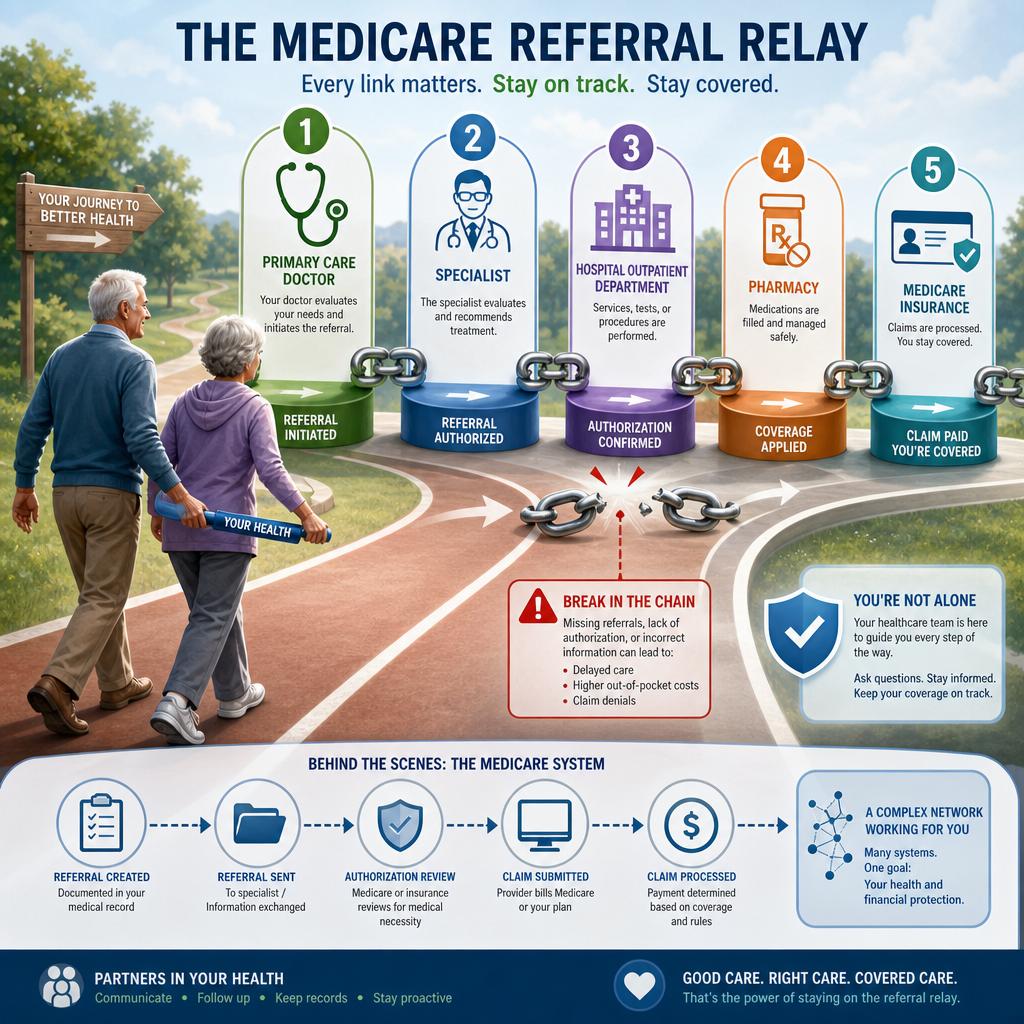
A retired couple can do nearly everything right and still be surprised by Medicare. Imagine Linda, age seventy one, whose primary care doctor sends her to a cardiologist after a concerning office visit. The cardiologist orders a stress test at a hospital outpatient department, changes one medication, and recommends a follow up with an electrophysiologist. Everyone involved is reputable. Every service sounds medically reasonable. Yet in 2026, the financial result can depend less on the diagnosis than on whether the right referral, authorization, network status, billing route, and plan card followed Linda through each step.
That is the referral relay risk. It is not the same as simply asking whether Medicare covers cardiology. Medicare may cover medically necessary doctor services, outpatient care, durable medical equipment, mental health services, preventive services, and limited outpatient prescription drugs under Part B, but coverage does not automatically mean every setting, specialist, or administrative path will price the same way. The 2026 Medicare handbook makes the contrast clear: Original Medicare generally lets you use any Medicare enrolled provider that accepts Medicare anywhere in the United States, while Medicare Advantage often requires network providers for non emergency care and may require referrals or prior authorization before certain services are covered .
Why A Referral Is Not The Same As Coverage
A referral is a clinical and administrative direction. It says, in effect, that one provider believes another provider should see you. It does not necessarily prove that your Medicare Advantage plan has approved the visit, that the specialist is in network, that the facility where the test is performed is in network, or that the service will be billed under the benefit category you expect. In Original Medicare, beneficiaries usually do not need a referral to see a specialist, and the 2026 handbook notes that you generally can go to any Medicare enrolled provider or facility that accepts Medicare patients anywhere in the United States . That freedom is one reason some people prefer Original Medicare with a Medigap policy and a Part D plan.
Medicare Advantage works differently. These plans are Medicare approved private plans that provide Part A and Part B benefits, and most include Part D drug coverage. But the plan becomes the operational doorway for most covered care. The handbook explains that, in many cases, a beneficiary must use providers who participate in the plan network, may need prior authorization for certain services or drugs, and may also need a referral to use a specialist . A primary care referral may get you an appointment, but it may not satisfy the plan rule for an imaging test, procedure, infusion, equipment order, or out of network specialist.
The Relay Can Break At The Facility Level
The most overlooked break in the relay often occurs after the specialist visit. A specialist may be in network, but the hospital outpatient department, imaging center, anesthesia group, laboratory, or durable medical equipment supplier connected to that specialist may not be. Under Original Medicare, your cost often turns on the Medicare approved amount, whether the Part B deductible applies, and the usual 20 percent coinsurance after the deductible when the provider accepts assignment. The handbook also warns that Original Medicare has no yearly out of pocket limit unless you have supplemental coverage such as Medigap, Medicaid, employer, retiree, or union coverage .
In a Medicare Advantage plan, the issue is different. Plans have a yearly limit on what you pay for covered Part A and Part B services, but that protection applies within the plan rules. The same 2026 comparison notes that Medicare Advantage plans may have different cost sharing for certain services, may have network requirements, and may require prior authorization before certain services or supplies are covered . A beneficiary may hear the comforting phrase, “Your plan has an out of pocket maximum,” and assume the matter is settled. It is not settled if the service is denied for lack of authorization, routed to a higher cost out of network tier, or performed by a nonparticipating provider when a participating option was required.
The Plan Card Is Part Of The Medical Record
One surprisingly practical rule for 2026 is that the right insurance card must be used every time. The handbook specifically reminds Medicare Advantage enrollees that they must use the card from their Medicare Advantage plan to get Medicare covered services . That may sound elementary, but it is a common source of claim confusion when a patient still keeps a red, white, and blue Medicare card in the wallet, has a separate dental or vision card, carries a Part D card from a prior year, or recently changed plans during open enrollment.
This matters because a provider office often builds the authorization request from the insurance information presented at check in. If the wrong card is scanned, the claim may be sent to the wrong payer, the prior authorization may never be requested from the active plan, or the pharmacy may bill an old drug plan. The result can look like a coverage denial when the real problem is a broken administrative chain. The patient usually discovers the mistake weeks later, after the appointment has occurred and the opportunity to choose a cleaner route has passed.
Drug Coverage Adds A Second Relay
A specialist visit can also trigger a drug decision. In 2026, Part D out of pocket spending for covered Part D drugs is capped at $2,100 for the calendar year, after which the beneficiary pays no copayment or coinsurance for covered Part D drugs for the rest of that year . That is a major protection, but it does not mean every medication ordered after a specialist visit is automatically easy to fill. The drug still must be covered by the plan, placed on a formulary tier, filled through an appropriate pharmacy arrangement, and sometimes approved through a plan process.
The distinction between a doctor administered drug and a pharmacy dispensed drug can also be consequential. Medicare Part B may cover certain infused or injected drugs given in a doctor’s office, while most outpatient prescriptions move through Part D or a Medicare Advantage plan with drug coverage. The handbook notes that Part B does not cover most drugs, with exceptions such as certain immunosuppressive drugs, hospice related drugs, some infused and injected drugs given in a doctor’s office, and insulin used with a traditional pump . When a specialist says, “Medicare covers this,” the next question is which part of Medicare, through which plan rule, at which location, and under which pharmacy or medical benefit.
The Questions To Ask Before The Appointment
The safest Medicare patients are not suspicious. They are specific. Before a specialist visit, procedure, imaging order, infusion, or equipment delivery, the patient or family should ask the plan and provider whether the ordering clinician is in network, whether the treating clinician is in network, whether the facility is in network, whether a referral is required, whether prior authorization is required, whether the service is being billed under Part A, Part B, or Part D, and whether the provider accepts assignment if the patient has Original Medicare.
Those questions may feel tedious, but they are not bureaucratic trivia. They are the difference between a benefit that functions and a benefit that exists only on paper. Medicare’s own comparison emphasizes that Original Medicare and Medicare Advantage are not simply two versions of the same experience. They differ in provider choice, referrals, prior authorization, cost limits, supplemental coverage, and drug coverage structure . The decision is not merely about premiums. It is about how care moves when your health becomes complicated.
The quiet value of professional Medicare guidance is that someone looks at the relay before it breaks. Vista Mutual helps clients compare Medicare Advantage, Medicare Supplement, and Part D strategies through the lens of real medical behavior, not just brochure benefits. If you want a 2026 Medicare review that examines your doctors, prescriptions, networks, authorization exposure, and worst case cost structure, Schedule your 2026 Medicare consultation.