The 2026 Medicare Screening To Diagnostic Switch That Can Change Your Bill
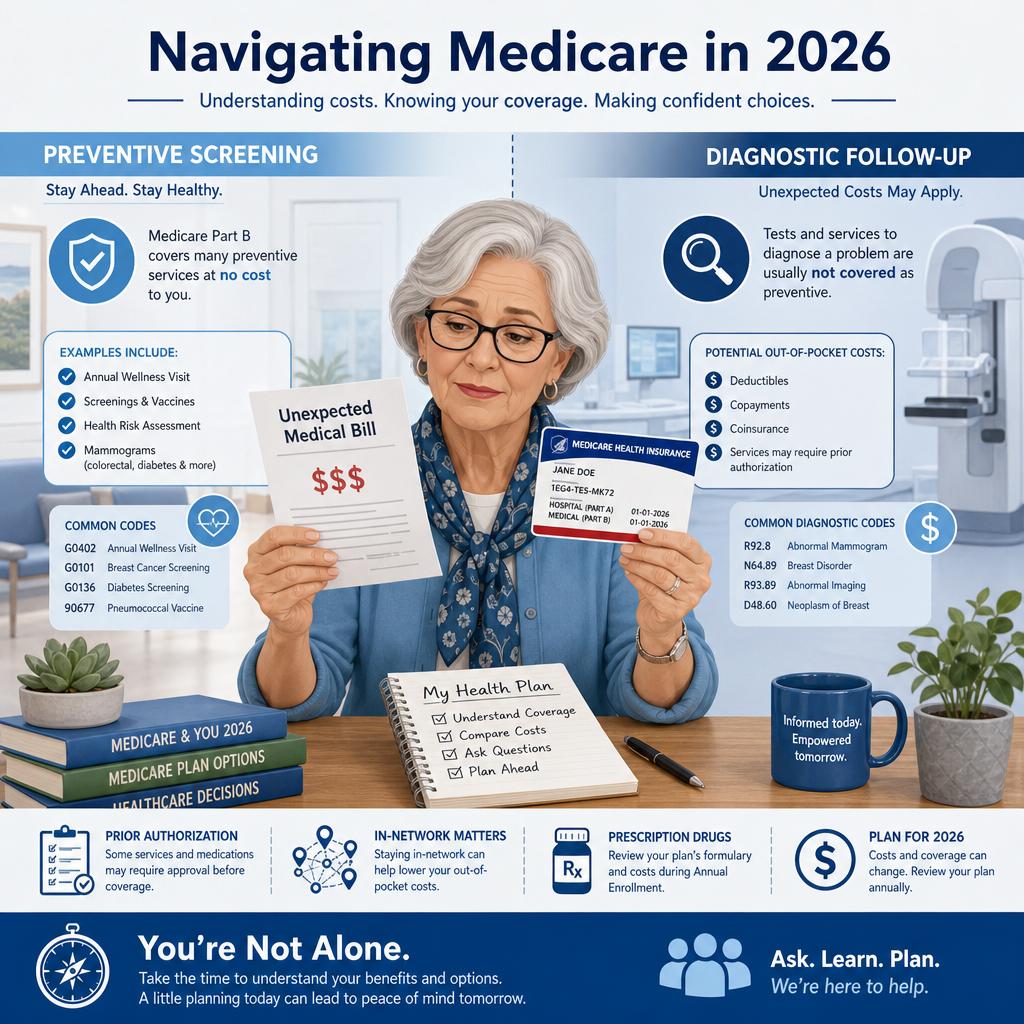
A retired teacher schedules what she believes is a routine screening. Her doctor agrees it is appropriate, the appointment is on the calendar, and she assumes Medicare will treat it like the preventive benefit she has heard about for years. Then the imaging center sees a prior abnormal result in her chart, the physician orders a closer look, or the test leads to a same day follow up discussion. Weeks later, a bill arrives, and the explanation is not that Medicare refused care. The explanation is more subtle: the service was no longer processed only as preventive.
That distinction matters in 2026 because Medicare coverage is not just about whether a service exists in the handbook. It is about why the service was ordered, how it was coded, where it was performed, and whether your plan applies Original Medicare cost sharing, Medicare Advantage copayments, network rules, or prior authorization. Medicare itself warns that most preventive services cost nothing when furnished by a provider who accepts assignment, but deductible or coinsurance can apply when a preventive service is combined with non-preventive care during the same visit . That single sentence is where many unexpected bills begin.
The Word Preventive Is Not A Price Guarantee
Preventive care under Medicare is designed to catch disease early, before symptoms force a more expensive and dangerous course of treatment. In everyday language, a patient may call almost any routine test a screening. Medicare uses a more precise framework. A true screening generally looks for disease in a person who meets eligibility rules but does not have signs, symptoms, or a recent abnormal finding that turns the encounter into active evaluation.
The practical difference can be significant. If a beneficiary has no symptoms and receives a covered preventive screening from a provider who accepts assignment, the cost may be zero. But if the test is ordered because of a symptom, a prior abnormality, a personal history that requires diagnostic follow up, or a physician concern that must be evaluated, the claim may move into the medical benefit side of Medicare. Medicare explains that Part B covers medically necessary doctor services, outpatient care, durable medical equipment, mental health care, limited outpatient prescription drugs, and many preventive services, and it may cover some services more often when needed to diagnose or treat a condition . That diagnostic purpose is often medically appropriate, but it may not be financially invisible.
The Same Building Can Produce A Different Bill
Consider a 2026 patient who arrives for a preventive screening and leaves with a diagnostic follow up order. The clinical care may be excellent. The financial experience can still be confusing. Original Medicare generally applies the Part B rules for medically necessary outpatient care, meaning the beneficiary may owe cost sharing after any applicable deductible. Medicare notes that after the Part B deductible is met, beneficiaries typically pay 20 percent of the Medicare approved amount when the provider accepts assignment, and Original Medicare has no yearly out of pocket limit unless the person has other coverage such as Medigap, Medicaid, employer, retiree, or union coverage .
The site of care can make the story more complicated. A physician office, an independent imaging center, and a hospital outpatient department may not bill the same way. A patient may focus on the test itself, while the claim separates the professional interpretation, the technical component, a facility charge, or a related office visit. For a beneficiary with a Medicare Supplement, some of that exposure may be absorbed depending on the policy. For a beneficiary in Medicare Advantage, the issue may shift toward copays, network status, plan rules, and whether the plan required an authorization before the diagnostic version of the service was performed.
Medicare Advantage Changes The Risk From Price To Permission
Medicare Advantage plans must cover the Part A and Part B benefits beneficiaries are entitled to receive, but they administer those benefits through plan designs that can include networks, copayments, referrals, and prior authorization. Medicare’s 2026 handbook emphasizes that Medicare Advantage costs depend on factors such as premiums, deductibles, copayments, whether care is in network, whether a provider contracts with the plan, and the plan’s yearly limit on out of pocket costs for Part A and Part B covered services . That yearly limit can be valuable, but it does not mean every service is automatically easy to access.
This is where the screening to diagnostic switch can surprise even careful retirees. A plan may treat the preventive screening as routine, but the diagnostic follow up may need a different authorization, a different place of service, or a different specialist. If the beneficiary assumes the original screening approval carries forward to the next step, the claim can become vulnerable. Medicare states that beneficiaries or providers can ask a Medicare Advantage plan in advance whether it covers a service, drug, or supply and how much it will cost, a process called an organization determination . In real life, that written answer may be the difference between confidence and months of appeals.
The Questions To Ask Before The Appointment
A polished Medicare strategy does not mean avoiding care. It means asking the right questions early, before the claim is created. The patient should not be expected to master coding, but the patient can create a paper trail that makes billing disputes easier to resolve. This is especially important when a test has a preventive version and a diagnostic version, or when the same appointment may include both.
Before a 2026 screening or follow up test, ask the scheduling office, ordering clinician, or plan these questions:
- Is this being ordered as a preventive screening, a diagnostic test, or surveillance because of a prior finding?
- Will there be a separate office visit, facility charge, reading fee, or specialist interpretation billed with the test?
- Does the provider accept Medicare assignment, or, in Medicare Advantage, is the provider and facility in the plan network?
- If the test changes from screening to diagnostic during the encounter, does the plan require prior authorization or a new order?
- If I receive a bill, what documentation should I request to confirm the diagnosis code, procedure code, and reason for the service?
These questions may feel unusually detailed, but they reflect how Medicare actually pays claims. The bill is not driven by the beneficiary’s expectation alone. It is driven by the medical record, the order, the claim codes, the provider’s relationship with Medicare or the plan, and the benefit category that applies.
Prescription Follow Up Can Add A Second Cost Layer
A screening that finds a new condition may also lead to medication. In 2026, that brings a separate set of rules under Part D. Medicare confirms that out of pocket costs for covered Part D drugs are capped at $2,100 in 2026, after which beneficiaries pay no copayment or coinsurance for covered Part D drugs for the rest of the calendar year . That is an important protection, but it only applies to covered Part D drugs and does not erase medical cost sharing for the screening, diagnostic workup, imaging, lab work, or physician visits that led to the prescription.
This separation is one reason Medicare planning cannot be reduced to premium shopping. A low premium Medicare Advantage plan may look attractive until the beneficiary needs multiple diagnostic follow ups across different facilities. A stand alone Part D plan may look inexpensive until a newly prescribed medication lands on a higher tier or requires a coverage determination. A Medigap policy may provide more predictable medical cost sharing, but it does not replace the need to evaluate Part D formularies. In 2026, the best decision is rarely about one benefit in isolation.
A Better Medicare Review Starts Before Something Looks Abnormal
The most expensive Medicare surprises often begin with an innocent assumption: my screening is covered, so everything connected to it must be covered the same way. Medicare is more nuanced. Preventive care, diagnostic care, treatment, prescription coverage, network access, and supplemental protection each have their own rules. When those rules overlap, a beneficiary needs more than a brochure. They need a plan review that anticipates how care actually unfolds.
Vista Mutual helps clients evaluate Medicare Advantage, Medicare Supplement, and Part D options through that real world lens. The goal is not to make Medicare feel simple when it is not. The goal is to make the complexity manageable, documented, and aligned with the doctors, prescriptions, and risks that matter most to you. For peace of mind before your next screening, follow up test, or annual plan decision, Schedule your 2026 Medicare consultation with the Vista Mutual team.