The 2026 Medicare Self Administered Drug Bill In Outpatient Hospital Care
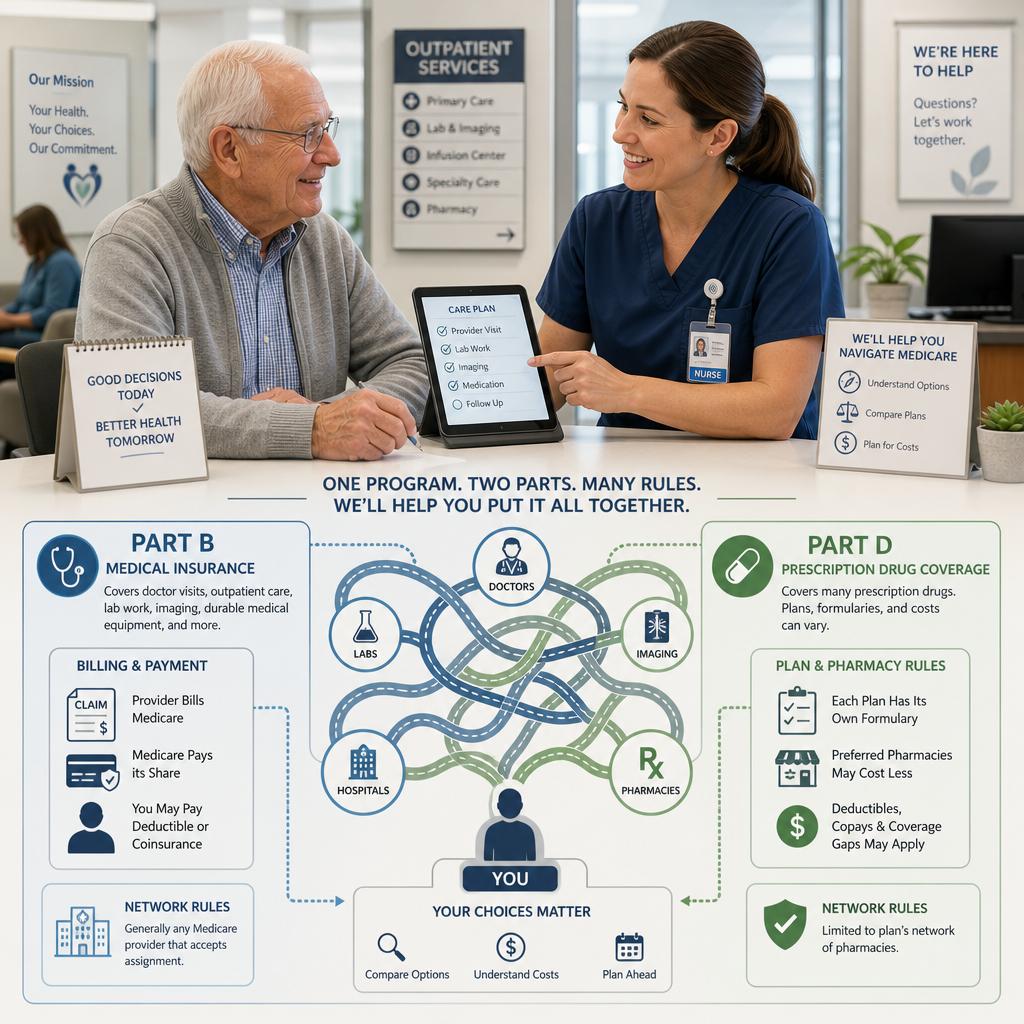
A Medicare beneficiary named Elaine goes to a hospital outpatient department in 2026 for a scheduled procedure. The nurse reviews her medications, the hospital supplies a pill she normally takes at home, and Elaine assumes everything provided inside the hospital will be handled under Medicare Part B. Weeks later, she receives a bill for a drug she did not recognize as separate from the procedure.
That moment is where Medicare becomes less like a simple insurance card and more like a set of intersecting payment rules. Medicare Part B may cover certain outpatient drugs, especially infused or injected drugs given in a doctor office or hospital outpatient setting, but Medicare also states that Part B does not cover self-administered drugs in a hospital outpatient setting, meaning drugs you would normally take on your own . For retirees comparing Original Medicare, Medicare Advantage, Medigap, and Part D coverage, this is not a small technicality. It is a planning issue.
Why A Hospital Supplied Pill May Not Be A Part B Drug
Many people understandably believe that if a medication is handed to them during a hospital outpatient encounter, it must be part of the hospital service. Medicare draws a sharper line. If the drug is part of the outpatient service, such as certain drugs administered as part of treatment, the cost may be handled through Part B rules. But if it is a self-administered drug, Part B generally does not pick it up simply because the hospital supplied it .
The practical problem is that patients often cannot tell the difference in real time. A medication given through an IV, a physician-administered injection, a pill given before a procedure, and a maintenance medication substituted from the hospital pharmacy may all feel like one episode of care. Medicare, however, may treat them differently. Under Original Medicare, many Part B covered services leave the beneficiary responsible for 20 percent of the Medicare-approved amount after any applicable deductible, and Medicare reminds beneficiaries that Original Medicare has no yearly out-of-pocket limit unless other coverage, such as Medigap, Medicaid, employer, retiree, or union coverage, applies .
The Part D Network Detail Patients Usually Learn Too Late
The next complication is Part D. Medicare says what you pay for self-administered drugs in a hospital outpatient setting depends on whether you have Medicare drug coverage or other drug coverage, and whether the hospital pharmacy is in your drug plan network . That sentence carries more weight than most people realize. A hospital may be fully appropriate for the procedure, the physician may accept Medicare, and the facility may be in your Medicare Advantage network, while the pharmacy transaction still fails to behave like a normal preferred retail pharmacy claim.
In 2026, the Part D out-of-pocket cap is an important protection, but it is not a magic eraser for every drug-related charge. Medicare states that yearly out-of-pocket drug costs for covered Part D drugs are capped at $2,100 in 2026, after which you owe no copayment or coinsurance for covered Part D drugs for the rest of the calendar year . The key phrase is covered Part D drugs. A hospital invoice for a self-administered drug may require plan review, possible reimbursement steps, and attention to whether the charge can be recognized under the drug plan at all.
Medicare Advantage Adds A Different Kind Of Question
For Medicare Advantage members, the issue is not always easier. Medicare Advantage plans must cover medically necessary services that Original Medicare covers, and most include Part D, but they can have networks, referrals, prior authorization, and plan-specific rules that shape how a service, supply, or drug is paid . The fact that a plan has drug coverage does not mean every hospital pharmacy charge will process cleanly at the point of service.
This is where the insider question changes. The question is not only, Does my plan include Part D? It is, How will my plan treat outpatient hospital drugs that are not covered by Part B? Medicare explains that beneficiaries or providers can ask a Medicare Advantage plan in advance for a decision on whether a service, drug, or supply is covered and what the beneficiary will have to pay. This is called an organization determination, and it may function as prior authorization for certain items .
The Four Questions To Ask Before An Outpatient Procedure
Before a planned outpatient hospital visit, especially one involving surgery, imaging with medication, infusion, observation, or recovery time, it is reasonable to ask more precise questions than a brochure will suggest:
- Will any medications be supplied by the hospital pharmacy that I normally take myself at home?
- If yes, will those medications be billed as part of the outpatient service, billed separately, or considered self-administered drugs?
- If a separate drug charge is created, can it be submitted to my Part D plan, and is the hospital pharmacy in my plan network?
- If I have Medicare Advantage, can the plan issue an organization determination before the procedure?
These questions are not adversarial. They are the kind of careful preparation that prevents a clean medical encounter from becoming a messy billing problem. They also help clarify whether it is wiser to use Original Medicare with a Medigap policy, a Medicare Advantage plan with stronger local hospital coordination, or a Part D plan with more forgiving pharmacy network access.
Why This Belongs In A 2026 Plan Review
The self-administered drug issue is easy to miss because it rarely appears as a headline benefit. People compare premiums, dental allowances, copays, drug tiers, and preferred pharmacies. Those comparisons matter. Yet a single outpatient hospital event can expose whether the plan design works in the real world.
The 2026 Medicare handbook makes clear that Medicare beneficiaries should review health and drug coverage each year and decide whether their current coverage still meets their needs . That annual review should include more than monthly premiums. It should include the hospitals you use, the specialists who treat you, the drugs you take at home, the Part D formulary, the pharmacy network, and the procedures you are reasonably likely to need in the coming year.
The Planning Value Of Seeing The Whole System
Medicare is not one rulebook. It is a coordination system. Part B may cover one drug, Part D may cover another, a hospital pharmacy may sit outside your normal retail experience, and a Medicare Advantage plan may require a different pre-service pathway. None of this means the system is impossible. It means the decisions deserve more care than a quick premium comparison.
Vista Mutual Insurance Services helps clients look beyond the surface of a plan and test how coverage may behave when care becomes complicated. If you want a calmer, more informed 2026 Medicare decision, Schedule your 2026 Medicare consultation with the Vista Mutual team.