The HSA Medicare Collision In 2026
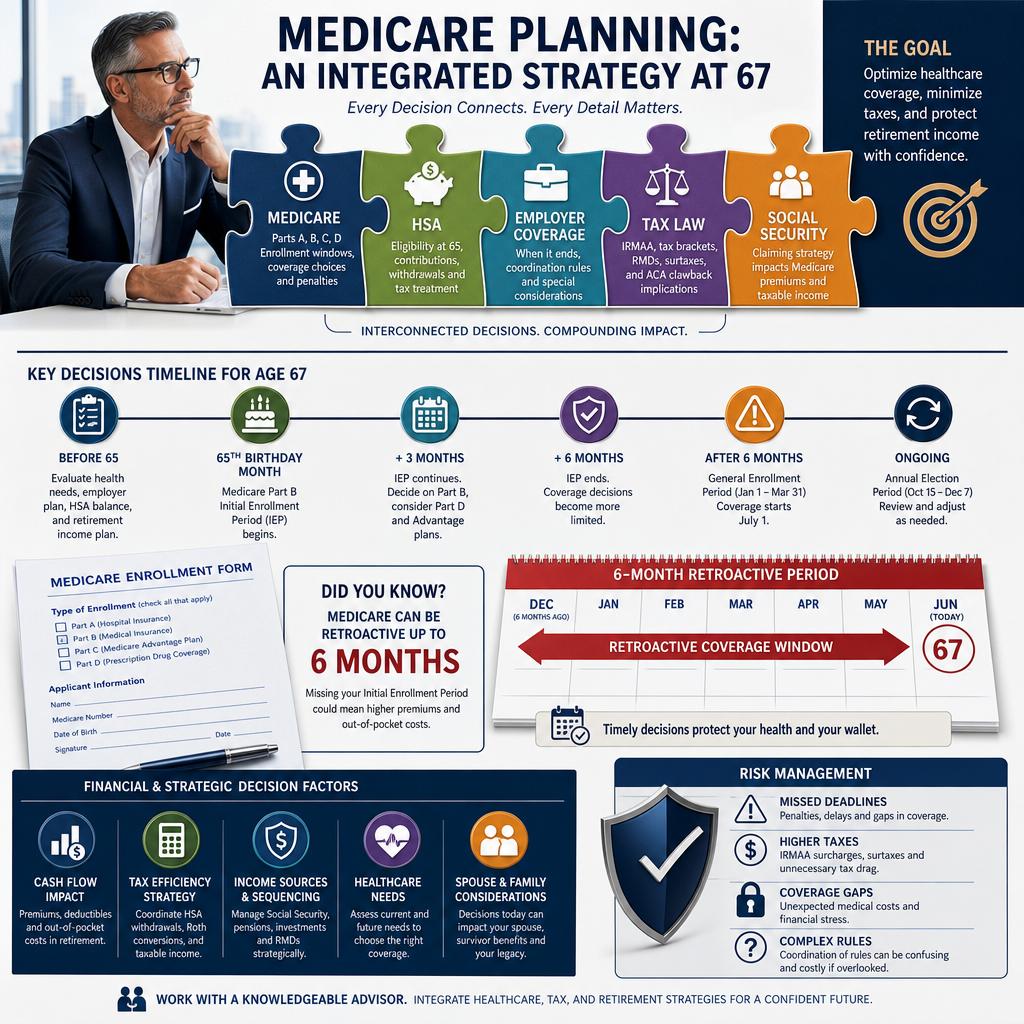
A 67 year old executive can feel fully insured and still be one enrollment form away from a Medicare mistake. She has a high deductible employer plan, contributes the maximum to her Health Savings Account, sees Medicare as something she will handle when she retires, and assumes that because she has excellent coverage at work, nothing urgent is happening. Then she applies for Social Security or enrolls in Medicare Part A, and discovers that premium free Part A may be retroactive for up to 6 months, but not earlier than the first month she was eligible for Medicare. The Medicare handbook specifically warns that HSA contributions should generally stop the month before Part A begins because having Medicare makes a person ineligible to contribute to an HSA .
That is the kind of rule that does not announce itself on a benefits portal. It lives in the seam between tax law, employer plan design, Social Security timing, and Medicare eligibility. For 2026, as more people work well beyond 65 and use HSAs as part of their retirement strategy, this seam deserves serious attention. Medicare planning is not simply choosing between a Medicare Advantage plan and a supplement. Sometimes the highest value decision is knowing when not to enroll yet, when to stop contributing, and how to avoid turning a tax advantaged account into a compliance problem.
Why HSA Contributions Become Risky Around Medicare Eligibility
The core rule is deceptively simple. Once you have Medicare, you cannot make or receive contributions to an HSA. That includes your own payroll contributions, employer contributions, and sometimes contributions that were scheduled automatically months earlier. The complication is that Medicare Part A does not always begin on the date a person thinks it begins. If you sign up for premium free Part A after 65, Medicare may make that Part A coverage retroactive for up to 6 months, limited by the month you first became Medicare eligible .
In practical terms, the person who retires in July 2026 and enrolls in Part A at that time may find that the Medicare start date reaches back into January 2026. If HSA contributions continued during those months, the contributions may need to be corrected. The exact tax handling should be reviewed with a qualified tax professional, but the Medicare planning takeaway is clear. You do not want the Medicare application to be the first time anyone studies the HSA calendar.
The Working Past 65 Decision Is Not One Decision
Many people use a single phrase, working past 65, as if it produces a single Medicare answer. It does not. The right strategy depends on whether the employer coverage is based on current employment, how large the employer is, whether the worker or spouse is covered, whether the drug coverage is creditable, and whether the employee wants to keep funding an HSA. Medicare explains that when a person is still working and has employer coverage, they should contact the employer to confirm how that coverage works with Medicare . That instruction sounds ordinary, but it is one of the most important pieces of Medicare risk management.
The distinction between current employment coverage and other coverage is especially important. Medicare states that coverage based on current employment does not include COBRA, retiree coverage, VA coverage, individual Marketplace coverage, or former employer coverage received through severance or layoff . This matters because many people believe they are delaying Medicare safely because they still have some form of health insurance. In reality, the type of coverage can determine whether delaying Part B or Part D creates a penalty, a coverage delay, or an unexpected primary payer problem.
The Six Month Lookback Can Change A Retirement Timeline
Consider a person planning to retire on September 30, 2026. Their benefits department encourages them to sign up for Medicare in advance so coverage is ready on October 1. That may be perfectly appropriate from a medical coverage standpoint, but if the person is still contributing to an HSA in the months leading up to retirement, the Part A retroactivity rule can alter the financial outcome. A safer planning conversation often begins 6 to 8 months before the desired Medicare effective date, not 30 days before the employer coverage ends.
This is where high end Medicare guidance becomes very different from basic enrollment assistance. The question is not merely, what plan has your doctor. The question is, when should Part A begin, when should HSA contributions stop, does your employer coverage remain primary, does your spouse depend on the employer plan, and will the drug coverage protect you from a later Part D penalty. Each answer can affect the next one.
Part D Still Matters Even When You Are Healthy
HSA focused employees often think mostly about medical deductibles and tax savings, but prescription drug coverage still deserves attention. Medicare drug coverage has changed meaningfully for 2026. The handbook states that yearly out of pocket costs for covered Part D drugs are capped at $2,100 in 2026, after which no copayment or coinsurance is owed for covered Part D drugs for the rest of the calendar year . That cap is valuable, but it only helps if the person is properly enrolled in Part D or has a Medicare Advantage plan with drug coverage when Medicare drug coverage is needed.
The penalty rules can also surprise late retirees. Medicare explains that a Part D late enrollment penalty may apply if there is a period of 63 or more days in a row after the Initial Enrollment Period without Medicare drug coverage or other creditable prescription drug coverage, and that the penalty is generally added for as long as the person has Medicare drug coverage . For someone leaving employer coverage in 2026, confirming creditable drug coverage is not clerical housekeeping. It is the evidence that protects the future premium.
Original Medicare Medicare Advantage And The HSA Exit Strategy
The HSA issue usually appears before plan selection, but it should not be separated from plan selection. Original Medicare offers broad access to Medicare enrolled doctors and hospitals that accept Medicare, but the 2026 handbook is clear that Original Medicare has no yearly limit on what you pay out of pocket unless you have other coverage such as Medigap, Medicaid, employer, retiree, or union coverage . For a person leaving an employer plan, that unlimited exposure is one reason Medigap is often discussed alongside Part D.
Medicare Advantage plans work differently. They are offered by private Medicare approved companies, generally bundle Part A, Part B, and usually Part D, may require network use or approval for certain drugs and services, and include a yearly limit on out of pocket costs for covered Part A and Part B services . That structure may appeal to someone used to employer managed care, but the network and prior authorization rules must be evaluated carefully. The best choice is rarely determined by premium alone.
The Most Overlooked 2026 Planning Conversation
A beneficiary approaching retirement in 2026 should think of Medicare timing as a sequence rather than a switch. First comes employer coordination. Then comes the HSA contribution stop date. Then comes the Medicare effective date. Then comes the decision between Original Medicare with a supplement and drug plan, or Medicare Advantage. If prescription coverage is involved, the formulary, pharmacy arrangement, and drug tiering must be reviewed before the enrollment deadline, not after the first refill is rejected.
The danger is not that Medicare hides these rules. The danger is that the rules sit in different places. HR may know the employer plan. A tax preparer may know the HSA rules. Medicare may explain enrollment. A carrier may explain its plan. But the retiree needs someone to connect the full picture before a mistake becomes expensive.
For Vista Mutual clients, the goal is to bring order to that complexity. We help evaluate the timing of Medicare enrollment, the transition away from HSA eligibility, the role of employer or retiree coverage, and the plan design that fits the next stage of life. If you are working past 65 or planning a 2026 retirement, do not treat Medicare as a last minute form. Consult with the Vista Mutual team and build a Medicare strategy that protects both your coverage and your peace of mind.