The October First Medicare Review Window For 2026
Medicare decisions rarely go wrong all at once. More often, they go wrong quietly, when a beneficiary waits until the final week of Open Enrollment and tries to compare premiums, drug formularies, pharmacy contracts, physician networks, and prior authorization rules in one sitting. For 2026, that rushed approach is especially risky because the most visible number on a plan, the monthly premium, may be the least informative part of the decision.
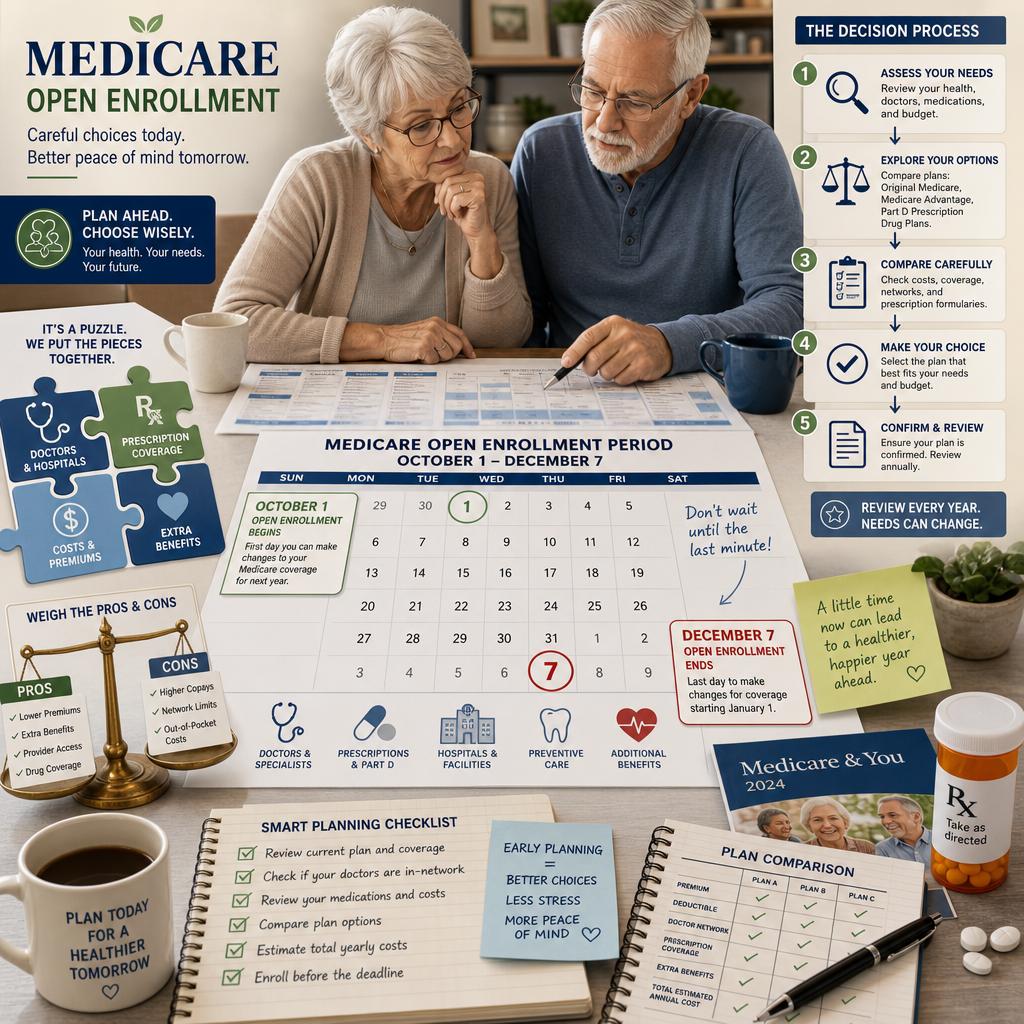
The official Medicare calendar gives beneficiaries an important head start. October 1, 2025 is the first day to begin comparing current Medicare health or drug coverage with 2026 options, while October 15 through December 7, 2025 is the period when most people may join, switch, or drop a Medicare Advantage Plan or Medicare drug plan for coverage effective in 2026 . That two week gap is not administrative trivia. It is the review window that separates a thoughtful Medicare strategy from a last minute enrollment choice.
Why October First Matters More Than Most People Realize
Picture a retired couple in early October. One spouse takes no daily prescriptions and sees a primary care doctor twice a year. The other takes a brand name heart medication, uses a preferred specialist, and may need an outpatient procedure in the spring. On paper, both may be attracted to the same low premium Medicare Advantage Plan. In practice, their Medicare risks are completely different.
That is why October 1 should be treated as a planning date, not merely a browsing date. Medicare tells beneficiaries to review health and drug coverage every year because plan costs and benefits can change, and the 2026 handbook specifically directs people to compare options before deciding whether to make a change . The beneficiary who waits until December may still have the legal right to change plans, but may not have enough time to understand the consequences.
The 2026 Drug Cap Is Helpful But Not A Substitute For Plan Review
One of the most important 2026 changes is the Part D out of pocket cap. Medicare drug coverage will cap yearly out of pocket costs for covered Part D drugs at $2,100 in 2026, after which the beneficiary owes no copayment or coinsurance for covered Part D drugs for the rest of the calendar year . This is meaningful protection, especially for people with high cost medications.
But the word “covered” carries a great deal of weight. The cap does not mean every drug will be on every formulary, that every pharmacy will price the medication the same way, or that every drug will avoid utilization rules. Medicare notes that actual drug costs depend on whether prescriptions are on the plan formulary, which tier applies, which pharmacy is used, whether the pharmacy has preferred or standard cost sharing, and whether the person qualifies for Extra Help . In other words, the cap reduces catastrophic exposure, but it does not erase the need to verify the path a specific prescription must travel through a specific plan.
The Low Premium Plan Can Still Be The Expensive Plan
Medicare Advantage Plans can be attractive because some charge a $0 premium, may include drug coverage, and may offer extra benefits. Yet the official comparison between Original Medicare and Medicare Advantage makes clear that these plans operate differently. With Original Medicare, beneficiaries can generally use any doctor or hospital that accepts Medicare anywhere in the United States, while Medicare Advantage members may need to use doctors and providers in the plan network and service area for non emergency care .
The cost structure also changes. Original Medicare generally leaves beneficiaries paying 20 percent of the Medicare approved amount for Part B covered services after the deductible, and it has no yearly out of pocket limit unless the person has supplemental coverage such as Medigap, Medicaid, employer coverage, retiree coverage, or union coverage . Medicare Advantage Plans, by contrast, have a yearly limit on what a member pays for covered Medicare services, but may require network use, referrals, or prior authorization for certain services .
That tradeoff is not good or bad in the abstract. It is personal. A healthy beneficiary with local doctors who participate in the plan network may value lower premiums and included extras. A beneficiary with complex specialists, frequent imaging, or seasonal travel may be more sensitive to network rules and authorization requirements. The October review window is when those differences should be tested against real life, not guessed from a brochure.
The Questions A Professional Review Should Ask Before December
A careful 2026 review is not just a plan ranking exercise. It is a fact finding process. The purpose is to uncover whether the plan that looks favorable in a search result still holds up under the pressure of actual doctors, actual prescriptions, actual pharmacies, and actual medical patterns.
One practical way to begin is to ask the following questions before choosing any 2026 plan:
- Are your primary doctor, key specialists, preferred hospital, and important pharmacies still participating for 2026, and are they in the lowest cost tier or preferred arrangement when tiers apply?
That single question often opens the deeper analysis. If a cardiologist is out of network, the advertised dental allowance is not the main issue. If a drug moved to a higher tier, the low premium may be offset quickly at the pharmacy counter. If a plan requires prior authorization for a service that Original Medicare usually would not require in the same way, convenience and timing become part of the cost.
Original Medicare With Medigap Is A Different Kind Of Risk Management
Some beneficiaries use the October period to compare Medicare Advantage Plans. Others use it to reassess whether Original Medicare with a Medigap policy and a separate Part D plan still fits their needs. This is where Medicare planning becomes especially technical, because Medigap is not simply another annual benefit election.
Medicare explains that Medigap can help pay certain out of pocket costs that Original Medicare does not cover, such as coinsurance, but beneficiaries cannot use Medigap to pay Medicare Advantage copayments, deductibles, or premiums . It is also illegal for someone to sell a Medigap policy to a person enrolled in Medicare Advantage unless that person is switching back to Original Medicare . For someone considering a move from Medigap into Medicare Advantage, that warning matters because dropping a Medigap policy may create underwriting or availability issues later, depending on timing, trial rights, and state rules.
This is one reason Vista Mutual treats plan selection as a sequence of decisions rather than a single premium comparison. The first question is not “Which plan is cheapest?” The better question is “Which structure creates the most predictable access, cost control, and flexibility for the way this person actually receives care?”
The December Seventh Deadline Rewards Preparation
By December 7, the enrollment decision must be made for most people who want 2026 changes through the fall Open Enrollment Period. The beneficiaries who use October well usually arrive at that deadline with fewer surprises. They have already checked prescription coverage, compared pharmacy pricing, reviewed network status, weighed prior authorization, and understood whether a Medicare Advantage or Original Medicare path better matches their care patterns.
The beneficiaries who wait often discover that Medicare is not one decision, but several decisions stacked together. A drug plan can be right for one medication and wrong for another. A Medicare Advantage Plan can include attractive extra benefits while still creating friction around a specialist. Original Medicare can provide broad provider access while leaving significant cost exposure unless paired with appropriate supplemental protection.
That complexity is exactly why professional guidance matters. A strong 2026 Medicare review should not pressure you toward a plan. It should slow the process down enough to reveal the tradeoffs before they become bills, denials, or access problems. If you want clarity before the Open Enrollment deadline, Schedule your 2026 Medicare consultation with Vista Mutual and approach the season with confidence rather than guesswork.