TRICARE CHAMPVA And Medicare In 2026 The Coordination Mistake Retirees Miss
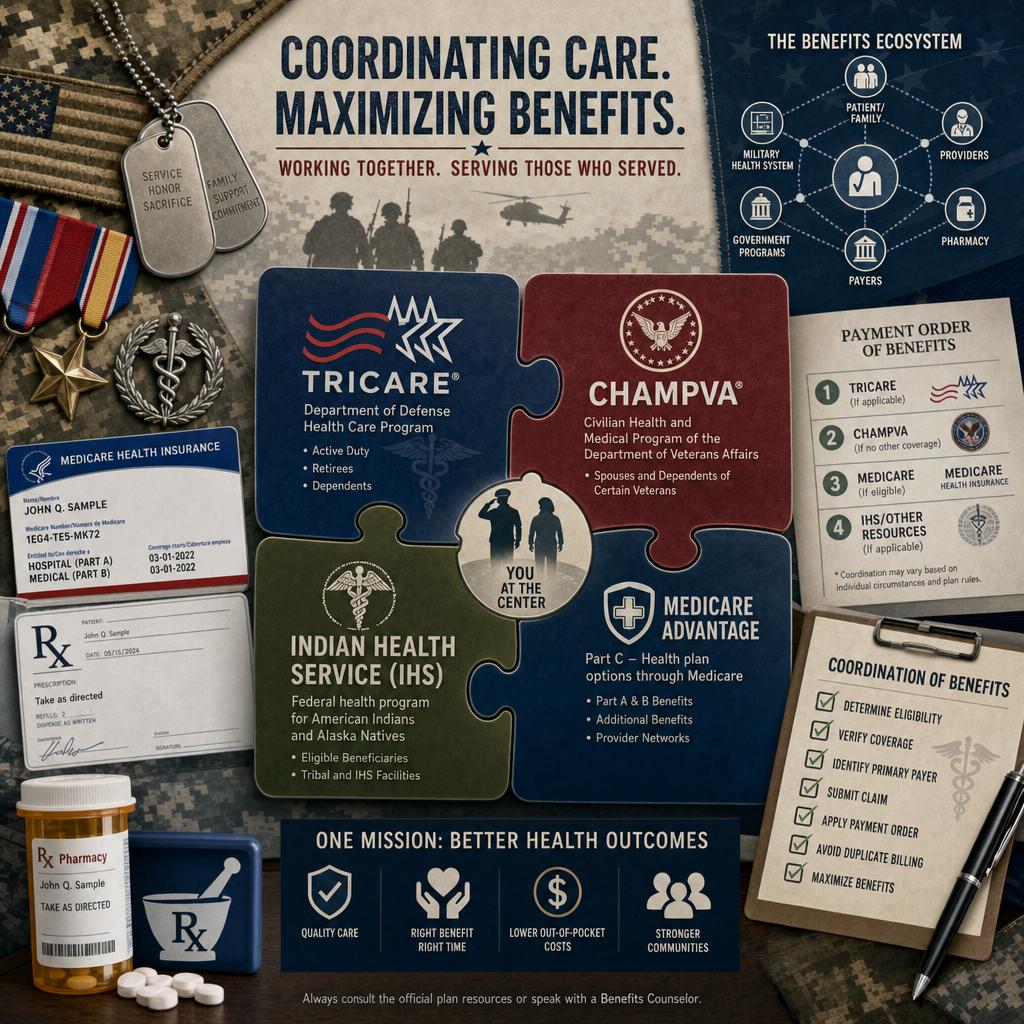
For many military families, Medicare does not arrive as a clean starting line. It enters a household that may already have TRICARE, CHAMPVA, VA access, employer retiree coverage, or care through an Indian Health Service facility. The result is a decision that can look deceptively easy from the outside and become expensive once prescriptions, pharmacies, specialists, and plan networks collide.
Consider a retired service member turning 65 in 2026. He has used TRICARE for years, fills prescriptions through a familiar pharmacy, and assumes that any Medicare Advantage plan with a low premium will simply sit on top of what he already has. His spouse, covered through CHAMPVA, hears from a neighbor that Part D has a $2,100 out of pocket drug cap in 2026 and wonders whether she should enroll in a separate drug plan. Both are asking reasonable questions. The problem is that Medicare coordination is rarely about one benefit. It is about payment order, enrollment rules, pharmacy network overlap, and what happens when a plan card is used in the wrong sequence.
Why Military And Federal Coverage Makes Medicare More Complicated
Medicare’s own 2026 guidance makes one principle clear: when you have other insurance, the policy that pays first pays up to its limits, and the secondary payer may pay only after that, and not necessarily for every remaining cost . That sounds straightforward until a family has more than one point of care. A hospital claim, a specialist visit, and a prescription refill may each move through different systems, with different cards and different rules.
TRICARE has a particularly important Medicare connection. Most people with TRICARE who are entitled to Medicare Part A must also have Part B to keep TRICARE drug benefits . That single sentence carries more weight than many retirees realize. Delaying Part B may feel like a premium saving strategy, but for a TRICARE beneficiary it can affect the continuation of the broader military health benefit structure. In 2026, the analysis should not begin with whether a Medicare Advantage plan has a zero dollar premium. It should begin with whether the beneficiary has preserved the coverage foundation that TRICARE requires.
The Part D Cap Does Not Mean Everyone Needs A Part D Plan
The 2026 Medicare drug headline is significant. Medicare drug coverage will cap yearly out of pocket costs for covered Part D drugs at $2,100, after which the beneficiary pays no copayment or coinsurance for covered Part D drugs for the rest of the calendar year . For someone taking costly covered medications, that cap may materially change the plan comparison. It is one of the most important Medicare drug protections beneficiaries will see in 2026.
But the cap applies inside Medicare Part D. It does not automatically mean that every person with TRICARE, CHAMPVA, IHS access, or VA drug access should join a separate Part D plan. Medicare states that if you have TRICARE, you do not need to join a separate Medicare drug plan. If you do join one, the Medicare drug plan pays first and TRICARE pays second . That payment order matters because the decision is not just about whether a drug is covered somewhere. It is about which formulary applies first, which pharmacy can process both layers correctly, and whether the beneficiary is creating complexity without meaningful savings.
The Pharmacy Counter Is Where The Mistake Shows Up
The most common coordination error is not made in a conference room. It happens at the pharmacy counter on a Tuesday afternoon. A beneficiary hands over a new Medicare Advantage card with drug coverage, assuming the pharmacy will know how to run everything. If that plan’s network pharmacy is also in the TRICARE network, coordination may be smoother. Medicare’s 2026 handbook explains that when a Medicare Advantage plan with drug coverage and TRICARE are both involved, they may coordinate benefits if the Medicare Advantage network pharmacy is also a TRICARE network pharmacy. Otherwise, the beneficiary may need to file a claim to be reimbursed for out of pocket costs .
That is the hidden burden. A plan can look attractive during annual enrollment, yet create reimbursement friction in daily life. For a beneficiary managing insulin, anticoagulants, inhalers, cancer medications, or specialty drugs, the wrong pharmacy routing can become more than an inconvenience. It can affect cash flow, medication adherence, and trust in the coverage itself.
Here is the practical 2026 test Vista Mutual would want a military or federal family to run before making a change:
- Confirm whether Part B enrollment is required to preserve existing coverage, identify which card should be used first for medical claims, verify that the preferred pharmacy participates in every relevant network, compare the Medicare Part D formulary against the beneficiary’s actual prescriptions, and ask how reimbursement works if the claim does not coordinate automatically.
That is the only list in this article because the point deserves to stand alone. These are not abstract administrative questions. They are the questions that determine whether a plan works when care is needed.
CHAMPVA And IHS Beneficiaries Need A Different Lens
CHAMPVA and IHS coverage can also create decision traps, but not in the same way. Medicare’s 2026 materials describe CHAMPVA as a health care benefits program for certain spouses, surviving spouses, children, and primary family caregivers of qualifying Veterans, and the handbook directs beneficiaries to VA resources for more detail . For families using CHAMPVA, the Medicare decision often involves more than premium comparison. It may require confirming how Medicare enrollment affects CHAMPVA coordination, whether a Medicare Advantage network narrows access to preferred doctors, and how prescriptions are processed.
For American Indian and Alaska Native beneficiaries, Medicare notes that the Indian Health Service is the primary health care provider for this Medicare population, and that many Indian health facilities participate in Medicare drug coverage. If prescriptions are obtained through an Indian health facility, Medicare says beneficiaries can continue to get them at no cost and coverage will not be interrupted. Joining a Medicare drug plan or Medicare Advantage plan with drug coverage may also help the Indian health facility because the plan pays the facility for prescription costs . That is a different planning issue. The question is not merely, “Which plan is cheapest for me?” It may also be, “Which option supports the facility I rely on while preserving access to outside specialists if I need them?”
Medicare Advantage Can Help Or Complicate The Coordination
Medicare Advantage plans bundle Part A, Part B, and usually Part D into a private plan alternative to Original Medicare. They may offer extra benefits such as dental, hearing, vision, and other services not covered by Original Medicare, but they also may require network providers, referrals, or prior authorization for certain services and drugs . That tradeoff is central for beneficiaries with military or federal coverage because the extra benefits can be appealing, but coordination problems often emerge where networks and payment order meet.
Original Medicare generally allows use of any doctor or hospital that accepts Medicare anywhere in the United States, while Medicare Advantage usually requires use of providers in the plan network and service area for non emergency care. Original Medicare has no yearly out of pocket limit unless the beneficiary has supplemental protection such as Medigap, Medicaid, employer coverage, retiree coverage, or union coverage, while Medicare Advantage plans do have a yearly limit for covered Part A and Part B services . For a military retiree who travels frequently, receives care near a base, and uses civilian specialists in multiple states, that distinction may be decisive.
The 2026 Decision Is Really About Preserving Options
The most sophisticated Medicare planning often has less to do with chasing the richest advertised benefit and more to do with avoiding irreversible mistakes. A beneficiary who joins a Medicare Advantage plan may not be able to use a Medigap policy to pay that plan’s copayments, deductibles, or premiums, and Medicare warns that dropping Medigap to join Medicare Advantage can make it difficult or more expensive to get Medigap back later depending on state rules and the person’s situation . That issue can be especially important when a retiree is already relying on another coverage layer and assumes all supplemental protections are interchangeable.
In 2026, the families most at risk are not necessarily the ones with the least coverage. Often, they are the ones with the most moving parts. TRICARE, CHAMPVA, IHS access, VA pharmacy benefits, Medicare Advantage, Part D, Medigap, and employer retiree coverage can each be valuable. The danger comes from assuming they all coordinate automatically.
Vista Mutual’s role is to slow the decision down before the paperwork is signed. The right review looks at your doctors, prescriptions, pharmacies, travel pattern, military or federal benefits, household members, and tolerance for network management. Peace of mind comes from knowing not only what a plan promises, but how it will behave when another payer is involved. If you want a careful 2026 review before making a Medicare move, Consult with the Vista Mutual team.